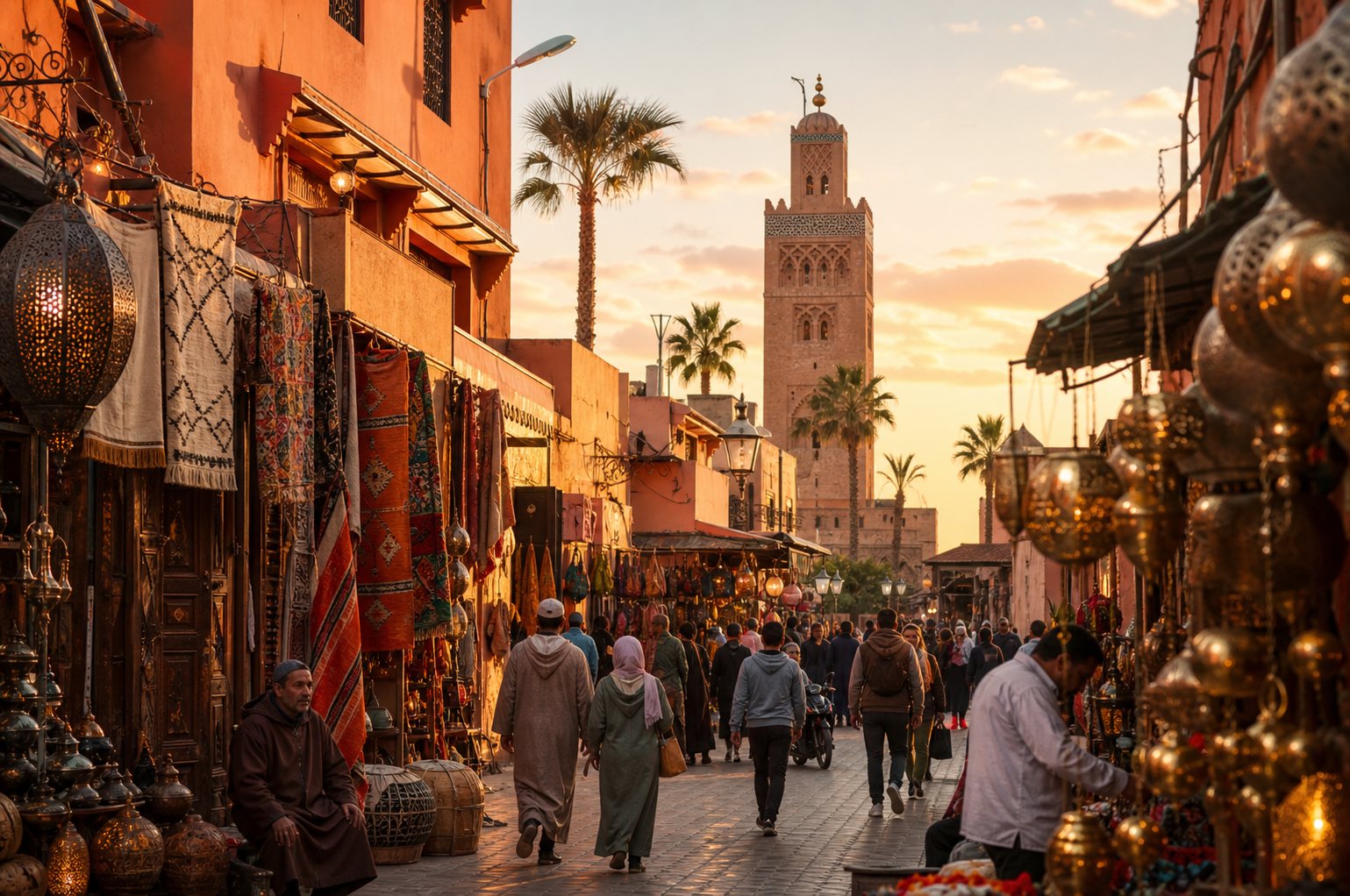
Morocco's museums are some of the best places to slow down and read the country's art, craft and history away from the crush of the souks. This guide rounds up the standouts city by city — from the Yves Saint Laurent Museum and the palace-museums of Marrakech to Fez's craft collections, Rabat's national museums (home to the famous Roman bronzes of Volubilis), Tangier's Kasbah Museum and American Legation, and the Cinema Museum in Ouarzazate — with a note on what each is best for. Opening hours and admission change, so always check the current details before you go.
In this guide
Marrakech: gardens, palaces and craft
Marrakech has the densest cluster of museums in the country, and most are housed in beautiful buildings that are half the reason to visit. The Yves Saint Laurent Museum, beside the Jardin Majorelle, is devoted to the designer's work and his long love affair with the city; it requires a separate ticket from the garden, and the two are often visited together. Within the Jardin Majorelle itself sits the small Berber Museum, a jewel-box collection of Amazigh (Berber) jewellery, textiles and artefacts displayed in the garden's cobalt-blue villa.
For palace architecture, the Bahia Palace is a sprawling late-19th-century vizier's residence of painted ceilings, courtyards and zellij — a museum of the building itself as much as anything inside it. Nearby, Dar Si Said is the city's museum of Moroccan arts and is especially strong on woodwork; it has been associated with carpets and decorative arts collections. The Marrakech Museum, set in the restored Dar Menebhi palace near the Ben Youssef Madrasa, shows Moroccan and contemporary art around a spectacular tiled central court.
Two smaller museums reward the curious. The Maison de la Photographie, in a restored house in the medina, gathers vintage photographs of Morocco from the 19th and early 20th centuries and has a rooftop café with medina views. The Tiskiwin Museum — the Bert Flint collection — traces the trans-Saharan trade and culture along a journey from Marrakech to Timbuktu, room by room, and is one of the most distinctive small museums in the city.
- Yves Saint Laurent Museum — the designer's work; beside Jardin Majorelle, separate ticket. Best for fashion and design lovers.
- Berber Museum (in Jardin Majorelle) — Amazigh jewellery, textiles and artefacts. Best for craft and culture.
- Bahia Palace — painted ceilings, courtyards and zellij. Best for palace architecture.
- Dar Si Said — Moroccan arts, especially woodwork. Best for decorative crafts.
- Marrakech Museum (Dar Menebhi) — art in a restored palace. Best for the building and Moroccan art.
- Maison de la Photographie — vintage photographs of Morocco; rooftop café. Best for history buffs.
- Tiskiwin / Bert Flint Museum — Saharan trade and culture, Marrakech to Timbuktu. Best for the offbeat.
Fez: ceramics and the woodworkers' craft
Fez, the country's craft capital, has two museums worth building time around. Dar Batha (the Batha Museum) occupies a former palace with an Andalusian garden and holds a celebrated collection of Fez arts and crafts — most famously the cobalt 'Fez blue' ceramics, alongside carved wood, embroidery, carpets and astrolabes. It's the ideal place to understand the city's craft traditions before you plunge into the medina to see them being made.
The Nejjarine Museum of Wooden Arts and Crafts sits on the lovely Nejjarine square, with its fountain, and is housed in a beautifully restored fondouk (caravanserai). The displays of carved cedar, tools, doors and traditional woodwork explain the craft that decorates the city's madrasas and homes, and the rooftop terrace gives one of the best free-standing views over the Fez medina.
- Dar Batha (Batha Museum) — Fez-blue ceramics, woodwork and crafts in a palace garden. Best for traditional craft.
- Nejjarine Museum of Wooden Arts — carved cedar and woodwork in a restored fondouk; rooftop view. Best for craft and architecture.
Rabat: modern art and the Roman bronzes
The capital holds two of Morocco's most important national collections. The Mohammed VI Museum of Modern and Contemporary Art (often shortened to MMVI) is the country's flagship modern-art museum, with a permanent collection of 20th- and 21st-century Moroccan artists and a strong programme of temporary exhibitions; it's a short walk from the medina and a refreshing counterpoint to the historic monuments.
The National Museum, also presented as the Museum of History and Civilisations, is the place to see Morocco's archaeology — and above all the famous Roman bronzes excavated at Volubilis, the well-preserved Roman city near Meknes. These ancient sculptures are among the finest classical antiquities in the country, and seeing them here adds enormously to a later visit to the Volubilis site itself.
- Mohammed VI Museum of Modern & Contemporary Art (MMVI) — Morocco's flagship modern-art collection. Best for contemporary art.
- National Museum / Museum of History & Civilisations — archaeology and the Roman bronzes from Volubilis. Best for ancient history.
Tangier: a kasbah palace and a piece of American history
Tangier's two essential museums sit inside the medina. The Kasbah Museum occupies the Dar el Makhzen, the former sultan's palace at the highest point of the old city, and displays Moroccan arts, antiquities and archaeology in handsomely tiled rooms; its gardens and terraces also offer some of the best views over the Strait of Gibraltar.
A few lanes away, the Tangier American Legation is a remarkable survival: a historic consular building that is the only United States National Historic Landmark located on foreign soil. It documents the long relationship between Morocco and the United States — Morocco was among the first countries to recognise American independence — and includes a section devoted to the writer Paul Bowles and Tangier's mid-century literary scene.
- Kasbah Museum (Dar el Makhzen) — Moroccan arts and antiquities in the former sultan's palace; great views. Best for art and the setting.
- Tangier American Legation — the only US National Historic Landmark abroad; Moroccan–US history and the Bowles literary scene. Best for history and literature.
Ouarzazate and beyond: cinema and a mosque you can enter
Ouarzazate has long been Morocco's film capital, with major studios on its edge, and the small Cinema Museum in the town centre celebrates that history with sets, props and equipment from the many international productions shot in the region. It's a light, fun stop that pairs naturally with a visit to the nearby ksar of Aït Benhaddou.
Casablanca offers a different kind of cultural visit. The Hassan II Mosque is one of the very few mosques in Morocco that non-Muslims can enter, and on a guided tour you can see not only the vast prayer hall but the hammam and ablution spaces beneath it — effectively a museum-like window onto a working religious complex and the craftsmanship of contemporary Moroccan artisans. Tours run at set times, so check the current schedule before you go.
- Cinema Museum, Ouarzazate — sets and props from films shot in the region. Best for film fans and a Aït Benhaddou day.
- Hassan II Mosque, Casablanca — guided tours of the prayer hall and the hammam/ablution spaces below; one of the few mosques open to non-Muslims. Best for architecture and craft.
Planning your museum visits
Opening hours, closing days and admission prices for Moroccan museums change fairly often, and some smaller collections close for restoration or over religious holidays — so it's always worth checking the current details, ideally the day before, rather than relying on a guidebook figure. Many museums close one day a week (frequently a Monday or Tuesday) and may shut for a long midday break.
A few practical habits help. Carry small dirham notes for entry, as card payment isn't universal. Photography rules vary — often allowed without flash, sometimes restricted, occasionally for an extra fee — so look for signs or ask. And because the best museums are clustered in the medinas, you can often pair two or three in a morning: a craft museum to learn the techniques, then the souks to see them practised. A licensed local guide can add a great deal of context to a palace-museum, though it isn't essential.
- Always check current opening hours and admission before visiting — specifics change.
- Many museums close one day a week and may have a midday break.
- Bring small cash; card payment isn't universal at smaller museums.
- Photography rules vary — no-flash, restricted, or a small fee in places.
Frequently asked
What are the best museums in Marrakech?
The standouts are the Yves Saint Laurent Museum beside the Jardin Majorelle (with the small Berber Museum inside the garden), the Bahia Palace, Dar Si Said for Moroccan arts and woodwork, the Marrakech Museum in the Dar Menebhi palace, the Maison de la Photographie and the offbeat Tiskiwin (Bert Flint) Museum on Saharan culture. Many sit close together in or near the medina.
Where can I see the Roman bronzes from Volubilis?
The famous Roman bronze sculptures excavated at Volubilis are displayed in Rabat, at the National Museum (also presented as the Museum of History and Civilisations). Seeing them there pairs well with a visit to the Volubilis archaeological site near Meknes itself.
Which museum is best for Moroccan crafts?
Fez is the craft capital: Dar Batha (the Batha Museum) is superb for Fez-blue ceramics and traditional arts, and the Nejjarine Museum of Wooden Arts covers carved cedar and woodwork in a restored fondouk. In Marrakech, Dar Si Said is the classic museum of Moroccan decorative arts, especially woodwork.
Can non-Muslims visit the Hassan II Mosque in Casablanca?
Yes. The Hassan II Mosque is one of the few mosques in Morocco open to non-Muslims, via guided tours at set times. The tour takes in the vast prayer hall and the hammam and ablution spaces beneath it, showcasing contemporary Moroccan craftsmanship. Check the current tour schedule before you go.
How much do museums cost in Morocco?
Admission varies by museum and changes over time, so it's best to check the current price when you plan your visit. Many smaller museums are inexpensive; flagship sites and palace-museums can cost more. Bring small dirham notes, as card payment isn't universal, and note that some museums offer reduced or free entry on certain days.
Planning a trip?
Let a Marrakech atelier handle the details.
Tell us your dates and style and we'll send a written itinerary and a transparent quote within 24 hours.
Request an itineraryKeep reading
Culture
A Guide to Moroccan Architecture & Decorative Arts
Moroccan architecture is a language of courtyards, fortresses and dazzling surface decoration. From the inward-looking riad and the earthen kasbah to zellij tilework, tadelakt plaster and carved cedar, this guide explains the building types and decorative arts you'll see across the medinas, palaces and southern oases.
Planning
Things to Do in Marrakech: The Essential Guide
Marrakech is sensory overload in the best possible way — a medieval medina, world-class gardens, hammam rituals, rooftop dinners and a square that transforms nightly into one of the world's great open-air spectacles. Here is where to spend your time.
Culture
Morocco's Dynasties: A Traveller's History You Can See
Much of what you'll admire in Morocco — the great mosques and minarets, the carved madrasas, the tombs and palaces — was built by a succession of ruling dynasties over more than a thousand years. This guide gives an accessible overview of the Idrisids, Almoravids, Almohads, Marinids, Saadians and the present Alaouite dynasty, tied to the monuments you can still visit today.