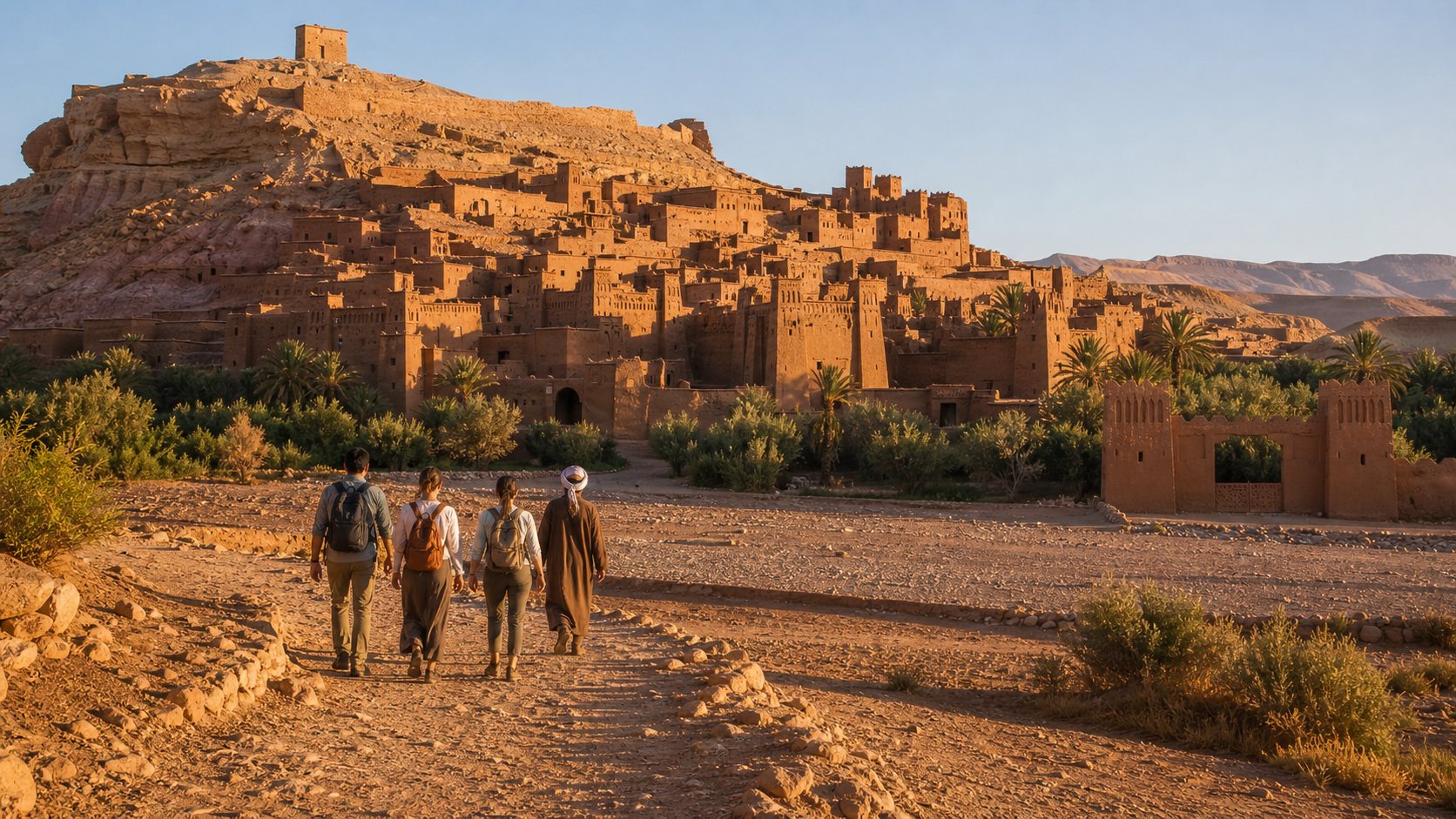
Moroccan architecture is a language of courtyards, fortresses and dazzling surface decoration. From the inward-looking riad and the earthen kasbah to zellij tilework, tadelakt plaster and carved cedar, this guide explains the building types and decorative arts you'll see across the medinas, palaces and southern oases.
In this guide
The courtyard house: riad and dar
The defining form of Moroccan domestic architecture is the courtyard house, built to face inward for privacy, shade and cool air. A riad is a house arranged around a planted interior courtyard or garden — the word riyad means garden in Arabic — usually with a central fountain and rooms looking onto the open centre. A dar is the broader term for a traditional house, often built around a smaller, paved courtyard.
From the street these houses present blank walls and a single decorated door; all the life and ornament is turned inward. Many have been converted into the guesthouses travellers now stay in, which is why so much Moroccan accommodation is described as a 'riad'. Roof terraces, mashrabiya screens and tiled fountains complete the type.
- Riad — house around a planted courtyard or garden.
- Dar — traditional house around a (usually paved) courtyard.
- Inward-facing: plain outside, ornate within.
Fortress and village: kasbah and ksar
In the south, architecture is earthen and defensive. A kasbah is a fortified house or citadel, typically square with high walls and tapering corner towers, built from pisé — rammed earth and mud brick — and often decorated with incised geometric patterns near the top. A ksar (plural ksour) is a fortified village: a whole community of homes, granaries and a mosque enclosed within shared walls.
The great example is the ksar of Aït Ben Haddou near Ouarzazate, a UNESCO World Heritage Site and a much-filmed cluster of earthen kasbahs rising above the river. These pisé structures are beautiful but fragile, needing constant re-plastering, and they line the southern valleys along the so-called Road of a Thousand Kasbahs.
- Kasbah — fortified house or citadel with corner towers.
- Ksar (pl. ksour) — fortified village of several families.
- Built from pisé: rammed earth and mud brick.
The medina, the madrasa and the fondouk
The medina is the old walled city — a dense maze of lanes, souks, mosques and houses that forms the historic core of cities such as Fez and Marrakech. Within it you find the great institutions of Islamic urban life. A madrasa is a Quranic school and college, often the most lavishly decorated building accessible to visitors; the Bou Inania and Al-Attarine madrasas in Fez are masterpieces of carved stucco, zellij and cedar.
A fondouk (also funduq) is a caravanserai — a merchants' inn and warehouse built around a large courtyard, with stabling and storage below and rooms above, once central to the trans-Saharan and regional trade. Many survive in the medinas, some now sheltering artisans' workshops. Mosques anchor each quarter, their square minarets — like the Almohad Koutoubia in Marrakech and the Hassan Tower in Rabat — defining the skyline.
- Medina — the old walled city and its souks.
- Madrasa — Quranic school, often the most ornate building.
- Fondouk / funduq — caravanserai inn around a courtyard.
Surface decoration: zellij, tadelakt and stucco
Moroccan buildings are famous less for their structure than for their surfaces. Zellij is the mosaic tilework of hand-cut, glazed terracotta pieces assembled into intricate geometric patterns — the dazzling tiled floors, fountains and dadoes (the lower band of a wall) seen in palaces and madrasas. Above the tilework, walls are often covered in carved stucco, known as gebs — plaster cut into lacework arabesques, calligraphy and geometric bands while still soft.
Tadelakt is the lustrous, waterproof lime plaster polished with stone and sealed with soap, traditionally used in hammams and now prized for bathrooms and walls for its smooth, seamless finish. Together these three crafts — tile, stucco and polished plaster — create the layered richness that distinguishes a Moroccan interior, usually arranged in horizontal zones up the wall.
- Zellij — hand-cut mosaic tilework in geometric patterns.
- Gebs — carved stucco plasterwork.
- Tadelakt — polished, waterproof lime plaster.
Wood, arches and the vocabulary of ornament
Carved and painted cedar woodwork crowns the finest rooms — coffered ceilings, doors, screens and the eaves of minarets — cedar being the prized timber of the Atlas. Where surfaces meet at ceilings and arches you often find muqarnas, the honeycomb or stalactite vaulting of clustered niches that softens the transition and catches the light.
The arches themselves are distinctive: the horseshoe arch, rounded and pinched in at the base, and the keyhole and multifoil (lobed) arches that frame doorways and prayer niches. The overall aesthetic avoids figural imagery in religious settings, favouring instead the endless interplay of geometry, calligraphy and stylised plant forms — the arabesque — repeated across tile, plaster and wood. Minaret form is itself a regional marker: Moroccan and wider Maghrebi minarets are typically square in plan, unlike the round or octagonal towers common further east.
- Cedar woodwork — carved ceilings, doors and screens.
- Muqarnas — honeycomb / stalactite vaulting.
- Horseshoe, keyhole and multifoil arches.
- Square minarets — a Moroccan and Maghrebi hallmark.
Frequently asked
What is the difference between a riad and a dar?
Both are traditional Moroccan courtyard houses that face inward for privacy. A riad is built around a planted interior garden or courtyard (riyad means garden), usually with a fountain, while a dar is the more general term for a traditional house, often arranged around a smaller paved courtyard. Many guesthouses today are converted riads.
What is zellij?
Zellij is Moroccan mosaic tilework made from hand-cut, glazed terracotta pieces fitted together into intricate geometric patterns. You see it on floors, fountains, walls and the lower dado band in riads, palaces and madrasas. It is one of the country's signature decorative crafts, alongside carved stucco (gebs) and tadelakt plaster.
What is the difference between a kasbah and a ksar?
A kasbah is a single fortified house or citadel, usually with high walls and corner towers, while a ksar (plural ksour) is a fortified village housing several families, with homes, granaries and a mosque inside shared walls. Both are built from earthen pisé and are typical of southern Morocco — Aït Ben Haddou is the most famous ksar.
Why are Moroccan houses plain on the outside?
Traditional Moroccan houses are built to face inward, presenting blank walls and a single decorated door to the street while reserving all the ornament — courtyards, fountains, tilework and carved plaster — for the interior. This gives privacy, shade and cooler air, which is why a modest doorway can open onto a lavish riad.
Planning a trip?
Let a Marrakech atelier handle the details.
Tell us your dates and style and we'll send a written itinerary and a transparent quote within 24 hours.
Request an itineraryKeep reading
Culture
Morocco's UNESCO World Heritage Sites
Morocco has nine UNESCO World Heritage Sites, all of them cultural — from the great imperial medinas of Fez and Marrakesh to the earthen ksar of Aït Ben Haddou, the Roman ruins of Volubilis and the Portuguese-built city of El Jadida. This guide describes each and shows how to weave them into a single trip.
Itineraries
The Road of a Thousand Kasbahs
The Road of a Thousand Kasbahs runs south and east from Ouarzazate through the Dadès and Draa valleys — past Skoura, the Valley of Roses, Boumalne Dadès and the great gorges — a landscape of fortified earthen kasbahs and palm oases that most travellers drive on the way to the Sahara.
Planning
Things to Do in Fes: The Essential Guide
Fes el-Bali is the world's largest inhabited medieval city — a UNESCO World Heritage medina of 9,400 lanes, 14th-century madrasas, the planet's oldest university and the Chouara tanneries. It demands a good guide, unhurried time and genuine curiosity.