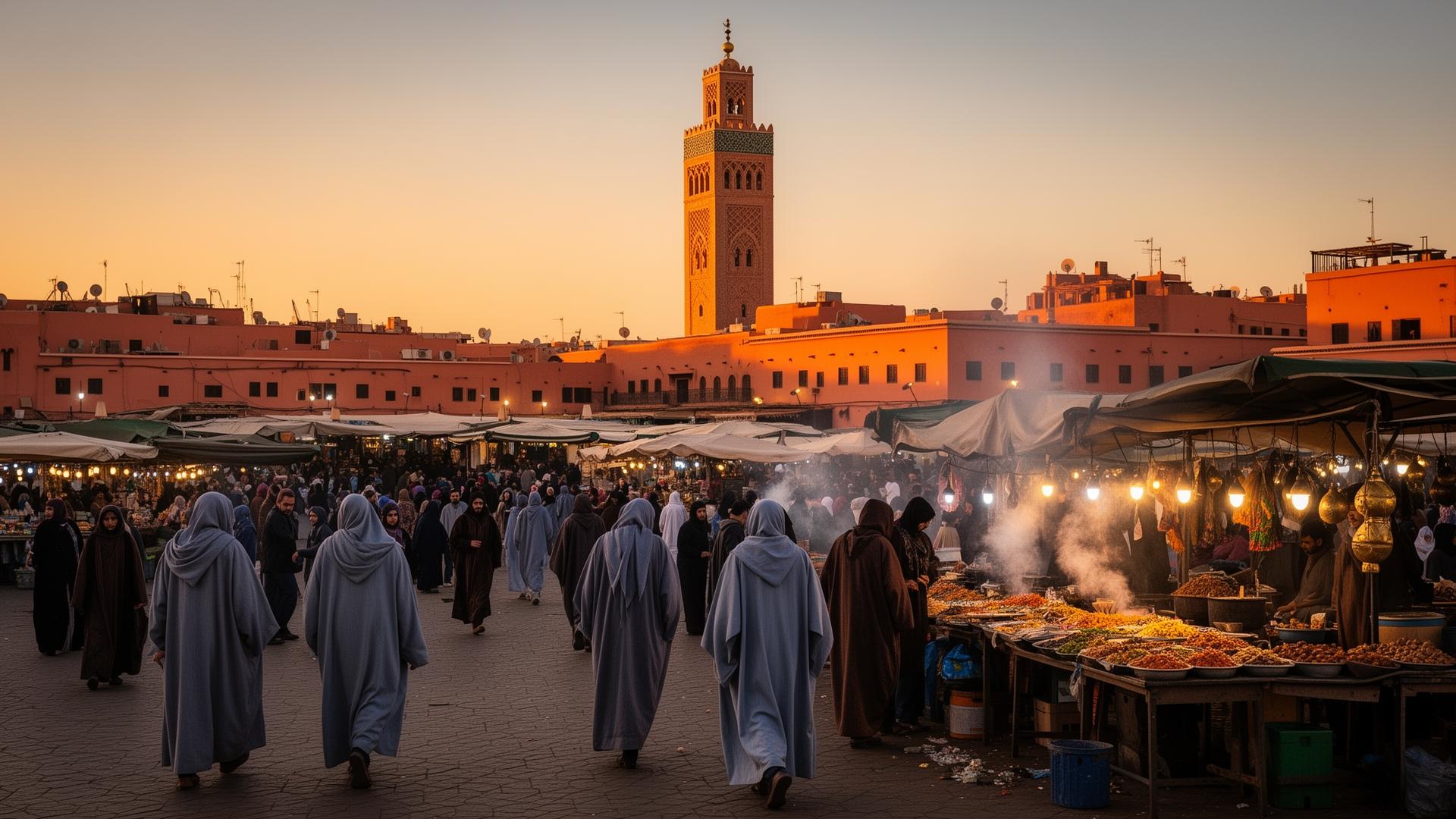
Marrakech is sensory overload in the best possible way — a medieval medina, world-class gardens, hammam rituals, rooftop dinners and a square that transforms nightly into one of the world's great open-air spectacles. Here is where to spend your time.
In this guide
What are the top sights in Marrakech?
Marrakech rewards wandering, but a handful of landmarks deserve deliberate visits. Jardin Majorelle — the cobalt-blue garden purchased and restored by Yves Saint Laurent — is the city's most photographed site, with a cactus garden, Berber museum and the Saint Laurent memorial pavilion on its grounds. Arrive at opening time (9am) to beat the tour groups. The Bahia Palace, a 19th-century vizier's residence of 150 elaborately decorated rooms around a series of riad courtyards, is one of the finest examples of Moroccan palace architecture open to the public.
The Medersa Ben Youssef — a Quranic school founded in the 14th century and expanded under the Saadian dynasty — has the most extraordinary carved cedarwood and stucco interior in the city. The central courtyard pool, the gallery of student cells above and the intricate zellige tilework at its base make it essential even for visitors who are not generally interested in historic architecture. Nearby, the Musée de Marrakech occupies a 19th-century palace and houses an excellent collection of Moroccan art and objects.
- Jardin Majorelle and the YSL Museum — arrive at 9am before tour groups.
- Bahia Palace — 150 decorated rooms; free for children under 6.
- Medersa Ben Youssef — finest Saadian-era interior in the medina.
- Musée de Marrakech — art and artefacts in a palace courtyard.
- Saadian Tombs — 16th-century royal mausoleum; small but atmospheric.
- Menara Gardens and the Almohad pavilion — best at sunset, with Atlas views.
- El Badi Palace — sprawling ruined 16th-century palace; storks nest on every wall.
What is there to do in Jemaa el-Fnaa?
Jemaa el-Fnaa — the vast central square of Marrakech's medina — is one of the world's great public spaces and UNESCO-listed as an intangible cultural heritage site. By day it is a marketplace of orange-juice stalls, henna artists, snake charmers and acrobats. From late afternoon onward it transforms: food stalls materialize in minutes, smoke rises from dozens of grills, and the square fills with storytellers, gnaoua musicians, and thousands of people. It peaks around 9–10pm and is worth sitting on a café terrace above it to watch.
Navigating Jemaa el-Fnaa well means keeping a few things in mind: agree a price with henna artists and food stall operators before engaging; keep your bag in front of you in crowds; and enjoy the snake charmers and water-sellers from a slight distance if you don't want to pay for a photo. The surrounding souks — leather, spices, lamps, textiles — fan out to the north and are best explored in the morning before the heat builds.
Which neighbourhoods should you explore in Marrakech?
The medina is not uniform. The area around Mouassine — roughly north-west of Jemaa el-Fnaa — has the best concentration of boutique riads, independent concept stores (33 Rue Majorelle, Max & Jan) and good independent restaurants. The area around Bab Doukkala is quieter and more residential, giving a sense of the medina as a place people actually live rather than a tourist spectacle. The mellah, the former Jewish quarter near the Bahia Palace, has a distinctly different architectural character — taller houses with balconies, a covered market, and the magnificent Lazama synagogue.
Gueliz, the French-era ville nouvelle west of the medina walls, is where contemporary Marrakech shops, eats and works. Mohammed V Avenue and the streets around it have international restaurants, art galleries and supermarkets — useful for orientation and essentials, and essential for understanding the city beyond the medina postcard.
What are the best day trips from Marrakech?
The High Atlas is 90 minutes away, and Imlil — the gateway village for Jbel Toubkal — makes a superb full-day excursion: a Berber village walk, a mule-track hike and a lunch of tagine in a mountain guesthouse. Ourika Valley (45 minutes) offers a waterfall hike through a Berber village and is ideal for a half day. Aït Ben Haddou — the UNESCO-listed kasbah that has appeared in Game of Thrones and Gladiator — is a full day return from Marrakech via the Tizi n'Tichka pass (4 hours each way), best done with a private driver who can stop at the pass viewpoints.
For a half-day closer to the city, the Palmeraie — the palm grove north of Marrakech — offers camel rides and a view of how the city edges into the desert. Essaouira (3 hours west) is a popular overnight excursion for those wanting Atlantic coast air, fresh seafood and a very different pace to the medina intensity.
- Imlil and the High Atlas — full day; 90 min each way; book a licensed guide.
- Ourika Valley — half day; waterfalls, Berber villages, tagine lunch.
- Aït Ben Haddou — full day return; UNESCO kasbah; worth the 4-hour drive.
- Essaouira — 3 hrs; best as an overnight to allow beach time and seafood.
- Palmeraie camel ride — 2 hours from the medina; short but atmospheric.
Where should you eat and drink in Marrakech?
The medina has two very distinct dining registers: the tourist restaurants on and around Jemaa el-Fnaa, which are atmospheric but inconsistent in quality, and the small neighbourhood dars and riads that serve set Moroccan menus by arrangement. For the latter, look for restaurants that post a menu in advance, accept reservations, and have consistent reviews mentioning fresh ingredients — Dar Moha (creative Moroccan), Le Jardin (medina garden restaurant), and Nomad (rooftop contemporary Moroccan) are benchmarks. Café des Épices on Rahba Lakdima square is the ideal spot for a late-morning mint tea overlooking the spice market.
For a truly local meal, seek out the small eateries in the lanes around Bab Doukkala for lamb brochettes and flatbreads at lunch — genuinely what Marrakchi families eat, at a fraction of tourist-facing prices. The Jemaa el-Fnaa food stalls (particularly the ones numbered rather than named, which indicates a city-registered operation) are lively but variable; the grilled sardines, snails in broth and msemen pancakes are safe bets.
What is the hammam experience like in Marrakech?
The traditional hammam — a public steam bath followed by an exfoliation with a kessa mitt and a black olive-soap (savon beldi) scrub — is one of Morocco's great rituals and should not be missed. Traditional neighbourhood hammams (such as Hammam Mouassine or Hammam el Bacha) charge 15–30 MAD for entry and operate separate male and female sessions; bring flip-flops, a change of underwear and a small towel. Tourist hammams (Les Bains de Marrakech, La Sultana Spa) offer the same experience in a more polished, English-speaking environment at US$40–120.
Booking a private hammam at your riad — if it has one — is the most convenient option and allows you to control timing. A gommage (full-body exfoliation) takes about 45 minutes and removes a remarkable quantity of dead skin. Argan oil massage is commonly added afterward and is genuinely restorative after a day of medina walking.
Frequently asked
How many days do you need in Marrakech?
Two nights allows the headline sights (Jardin Majorelle, Medersa Ben Youssef, Bahia Palace, Jemaa el-Fnaa at night) and a half day in the souks. Three nights is the comfortable standard — time for a hammam, a day trip to Imlil or the Ourika Valley, and at least one long medina wander without a checklist. Four or five nights suit those who want to slow down and do justice to the neighbourhoods.
What is Marrakech most famous for?
The Jemaa el-Fnaa square and its nightly spectacle, Jardin Majorelle and its YSL Museum, the intricate medina souks, the hammam tradition and the concentration of beautiful riad accommodation. It is also the gateway city for Sahara desert trips and Atlas mountain excursions.
Is Marrakech safe for tourists?
Yes. Violent crime against tourists is rare. The main issues are petty scams, persistent touts near Jemaa el-Fnaa and overcharging in taxis — all easily managed with a little preparation. Use agreed-price taxis or arranged transport, ignore false guides, and enjoy the city. The medina is perfectly safe to walk in daylight.
What is the best time of year to visit Marrakech?
March to May and September to November are the ideal windows — warm days (22–30°C), cool evenings, and comfortable sightseeing. July and August are very hot (regularly above 38°C); December to February are mild and bright with cold nights. Ramadan changes the rhythm of the day but adds a special evening atmosphere.
Can you visit Jardin Majorelle without booking?
Tickets can be bought at the gate, but the garden sells out during peak season (spring and autumn) by mid-morning. Online advance booking is strongly advised, especially for weekends and school holidays. The adjacent YSL Museum requires a separate ticket.
Planning a trip?
Let a Marrakech atelier handle the details.
Tell us your dates and style and we'll send a written itinerary and a transparent quote within 24 hours.
Request an itineraryKeep reading
Planning
The Best Time to Visit Morocco
Spring (March–May) and autumn (September–November) are the best all-round times to visit Morocco — warm days, cool evenings and ideal conditions for the medinas, mountains, coast and desert alike.
Itineraries
Morocco Itinerary: 7 Days
A week is enough to pair Marrakech with the Sahara, or to trace the imperial cities of the north. Here are two proven 7-day Morocco itineraries — and how to choose between them.
Planning
Trekking the Atlas Mountains: Toubkal, Imlil & Beyond
The High Atlas rises to 4,167 metres at Jbel Toubkal, North Africa's highest peak. Whether you want a single-day walk from Imlil, a multi-day village traverse or a summit attempt, the Atlas rewards it — with the right season, guide and preparation.
Planning
Morocco Honeymoon Guide
Morocco is one of the world's most atmospheric honeymoon destinations: private riad suites, candlelit desert camps, rose-petal hammams and a coastline that ranges from wild Atlantic to sheltered Mediterranean. Here is how to plan an unforgettable romantic trip.