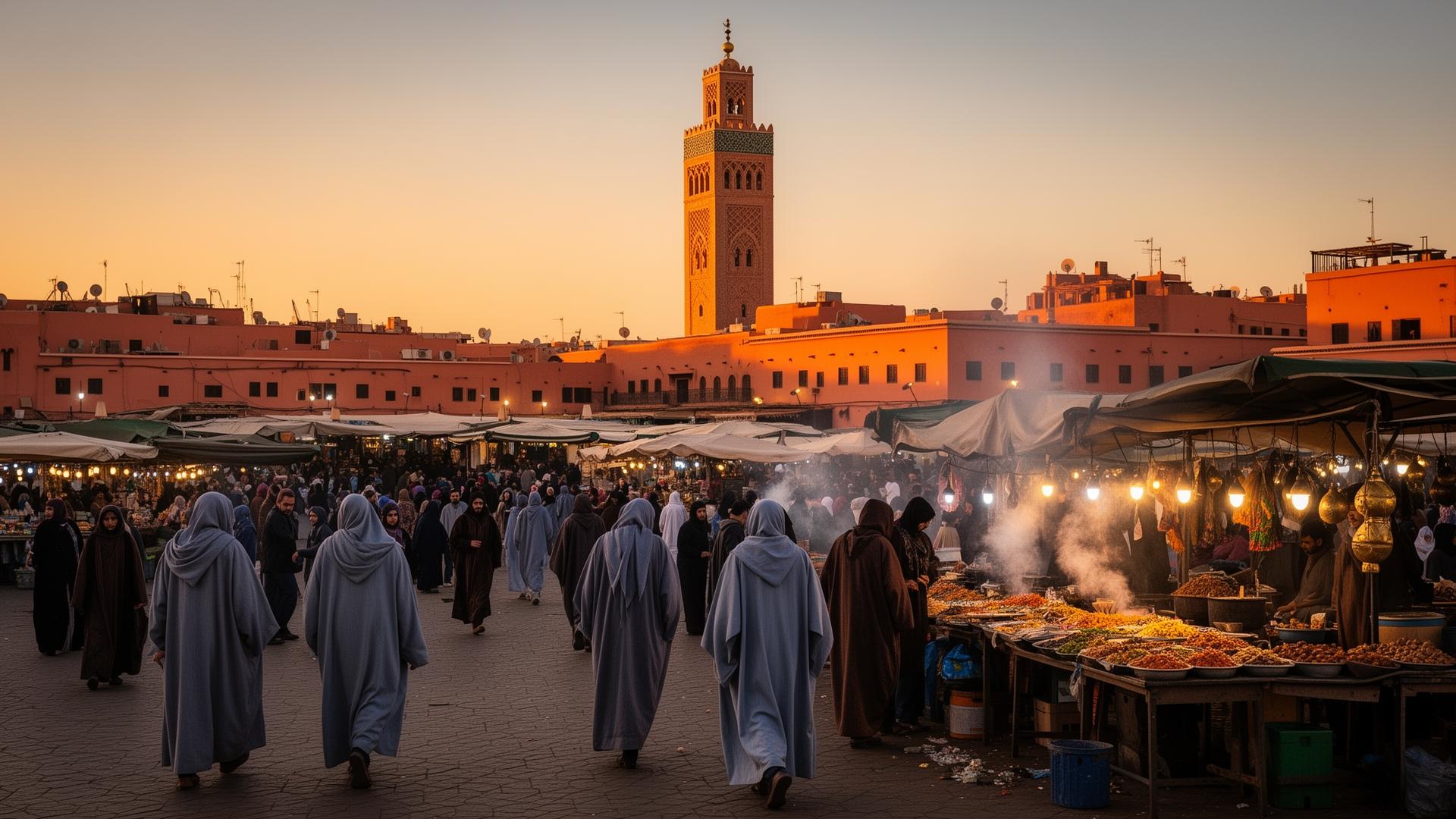
Rabat, Morocco's understated capital, rewards visitors with UNESCO-listed monuments, a royal kasbah, Roman ruins and a genuine daily-life rhythm entirely free from the tourist pressure of Marrakech or Fes.
In this guide
What are the top sights in Rabat's medina and kasbah?
The Kasbah of the Udayas — a 12th-century Almohad fortification perched above the Bou Regreg estuary — is Rabat's most atmospheric quarter. Within its walls, whitewashed houses with blue shutters line lanes barely wide enough for two people abreast. The Andalusian Garden at its heart is one of Morocco's most beautiful green spaces: clipped hedges, orange trees and a silence you will not find in any other Moroccan city centre. The kasbah gate (Bab Udaya), a masterpiece of Almohad carved stucco, is one of the finest examples of Moroccan medieval architecture still standing.
The Hassan Tower — an enormous unfinished minaret begun in 1195 under Sultan Yacoub al-Mansour, intended to be the tallest in the world — stands surrounded by the stumps of 200 columns, all that remains of what would have been the largest mosque in the western Islamic world. The Mausoleum of Mohammed V, directly alongside, is an active royal tomb of exquisite craftsmanship: white Carrara marble, cedarwood ceilings and a constant honour guard. Entry is free; modest dress is required.
- Kasbah of the Udayas — 12th-century Almohad citadel; Andalusian Garden; city's finest viewpoint.
- Hassan Tower and Mausoleum of Mohammed V — unfinished 12th-century minaret; royal mausoleum with honour guard.
- Chellah — Roman and Marinid ruins south of the city; storks nest on the ancient minarets.
- Mohammed VI Museum of Modern and Contemporary Art — one of Africa's best modern art museums; free on Sundays.
- Rabat medina — smaller and calmer than Marrakech or Fes; good textile and pottery shopping.
- Oudayas beach — surf beach immediately below the kasbah; popular with young Rabatis.
What is the Chellah and why is it worth visiting?
The Chellah (Shalla) is Rabat's most singular monument: a walled necropolis 2 km south of the medina that combines the remains of a Roman town (Sala Colonia, 1st–3rd century AD) with a 14th-century Marinid royal funerary complex. White storks nest on the Marinid minaret every spring, their nests piled metres high on the ancient stone, and the sound of them clattering above the ruined columns is genuinely arresting. The garden inside — wild figs, rose bushes and a pool where eels are fed sacred offerings — has an atmosphere unlike anywhere else in Morocco.
Entry costs approximately MAD 70. The Chellah is best visited in the late afternoon when the light falls golden across the Roman columns and the storks are most active (February to July). The site is uncrowded compared with the major medina monuments of Marrakech and Fes — one of Rabat's defining advantages as a destination.
What is the Mohammed VI Museum of Modern and Contemporary Art?
Opened in 2014, the Mohammed VI Museum of Modern and Contemporary Art (MMVI) is one of the finest art museums in Africa. Its permanent collection documents Moroccan modern art from the colonial period to the present day, with significant holdings of Expressionist, Abstract and contemporary Moroccan painters. The temporary exhibition programme regularly brings international contemporary art to Rabat. The building itself — a purpose-built six-storey modernist structure near the parliament — is designed to international museum standards, with good climate control, clear labelling in Arabic, French and English, and a well-stocked bookshop.
Admission is approximately MAD 60; free on Sundays. The museum is a 10-minute walk from the medina and is rarely crowded. For travellers interested in contemporary North African culture beyond the medina-and-souk narrative, it is unmissable.
How do you get to Rabat and how long should you stay?
Rabat is the most accessible of Morocco's major cities from Casablanca: the Al Boraq high-speed train covers the 90 km in under an hour, with trains running every 30–60 minutes from Casablanca Mohammed V Airport directly to Rabat Agdal station. From Fes, the ONCF train takes approximately 1.5 hours; from Tangier, 2 hours on the Al Boraq service via Casablanca. There is no direct international airport in Rabat — most fly into Casablanca and travel onwards by train.
Two nights is the comfortable duration: a full day for the Hassan Tower, Kasbah and Chellah, and a second day for the MMVI museum, the medina's textile quarter and the beach. Day trips from Casablanca are common but rushed — you see the monuments without the evening atmosphere of the kasbah at sunset or a mint tea in the Andalusian Garden.
- From Casablanca airport: Al Boraq high-speed train, under 1 hour, runs every 30–60 minutes.
- From Fes: ONCF train, approximately 1.5 hours.
- From Tangier: Al Boraq service via Casablanca, approximately 2 hours.
- Recommended stay: 2 nights — best suited to adding to an imperial cities itinerary.
Where should you eat in Rabat?
Rabat's dining scene is sophisticated by Moroccan standards — a capital city with a large resident diplomatic and governmental community supports a wider range of restaurants than its population alone would suggest. The Agdal and Hassan neighbourhoods have good contemporary Moroccan and international restaurants. For a medina lunch, the area around the Grand Mosque has unpretentious harira soup, brochette stalls and honest tagines at local prices. The Oudayas café, perched above the kasbah garden, is a reliable stop for mint tea with a harbour view.
Frequently asked
Is Rabat worth visiting in Morocco?
Yes — particularly for travellers seeking a calmer, more authentic Moroccan city experience than the tourist-heavy medinas of Marrakech and Fes. Rabat offers UNESCO-listed monuments, superb modern art and a daily rhythm that belongs to Moroccans rather than to tour groups. Two days is ideal alongside the imperial cities loop.
What is the Hassan Tower in Rabat?
The Hassan Tower is an enormous unfinished minaret begun in 1195 under the Almohad Sultan Yacoub al-Mansour, intended to top 86 m and serve the world's largest mosque at the time. The Sultan died in 1199; construction halted and the mosque was never completed. An earthquake in 1755 brought down most of the columns. What remains — the 44 m tower and 200 column stumps across a vast esplanade — is one of Morocco's most significant medieval monuments.
How do I get from Casablanca to Rabat?
The Al Boraq high-speed train is the easiest option — under an hour from Casablanca Mohammed V Airport directly to Rabat Agdal, running every 30–60 minutes. A taxi from Casablanca takes approximately 1.5 hours depending on traffic. Private drivers can also be arranged for the transfer.
What is the Kasbah of the Udayas?
The Kasbah of the Udayas is a 12th-century Almohad fortress on the promontory above the Bou Regreg estuary. Within its walls is a neighbourhood of whitewashed, blue-shuttered houses, an Andalusian garden and a small museum. The Bab Udaya gate — elaborately carved in Almohad stucco — is one of the finest surviving examples of Moroccan medieval architecture. Entry to the kasbah is free; the garden and museum charge a small fee.
What is the best time to visit Rabat?
Spring (March–May) and autumn (September–November) are ideal: mild temperatures, low humidity and good light. Summer is warm and dry (25–30°C); winter is mild with occasional rain. The Chellah storks are most spectacular February to July, which adds further incentive to a spring visit.
Planning a trip?
Let a Marrakech atelier handle the details.
Tell us your dates and style and we'll send a written itinerary and a transparent quote within 24 hours.
Request an itineraryKeep reading
Planning
Things to Do in Casablanca: The Essential Guide
Casablanca is Morocco's economic capital and largest city — a modern, cosmopolitan metropolis built on Atlantic commerce rather than imperial history. Its centrepiece, the Hassan II Mosque, is among the most extraordinary buildings in the world, and the city's restaurants, Corniche and Art Deco architecture reward those who linger beyond the airport transfer.
Planning
Things to Do in Fes: The Essential Guide
Fes el-Bali is the world's largest inhabited medieval city — a UNESCO World Heritage medina of 9,400 lanes, 14th-century madrasas, the planet's oldest university and the Chouara tanneries. It demands a good guide, unhurried time and genuine curiosity.
Planning
Things to Do in Meknes: The Essential Guide
Meknes — the fourth of Morocco's imperial cities and the least visited — rewards the traveller who lingers: a UNESCO medina, the monumental gates and granaries of Sultan Moulay Ismail's 17th-century capital, and the Roman city of Volubilis 33 km to the north.
Itineraries
Morocco Itinerary: 10 Days
Ten days is the sweet spot for Morocco — long enough to combine Marrakech, the Sahara and the imperial north in one unhurried loop, with the coast as an optional finish.