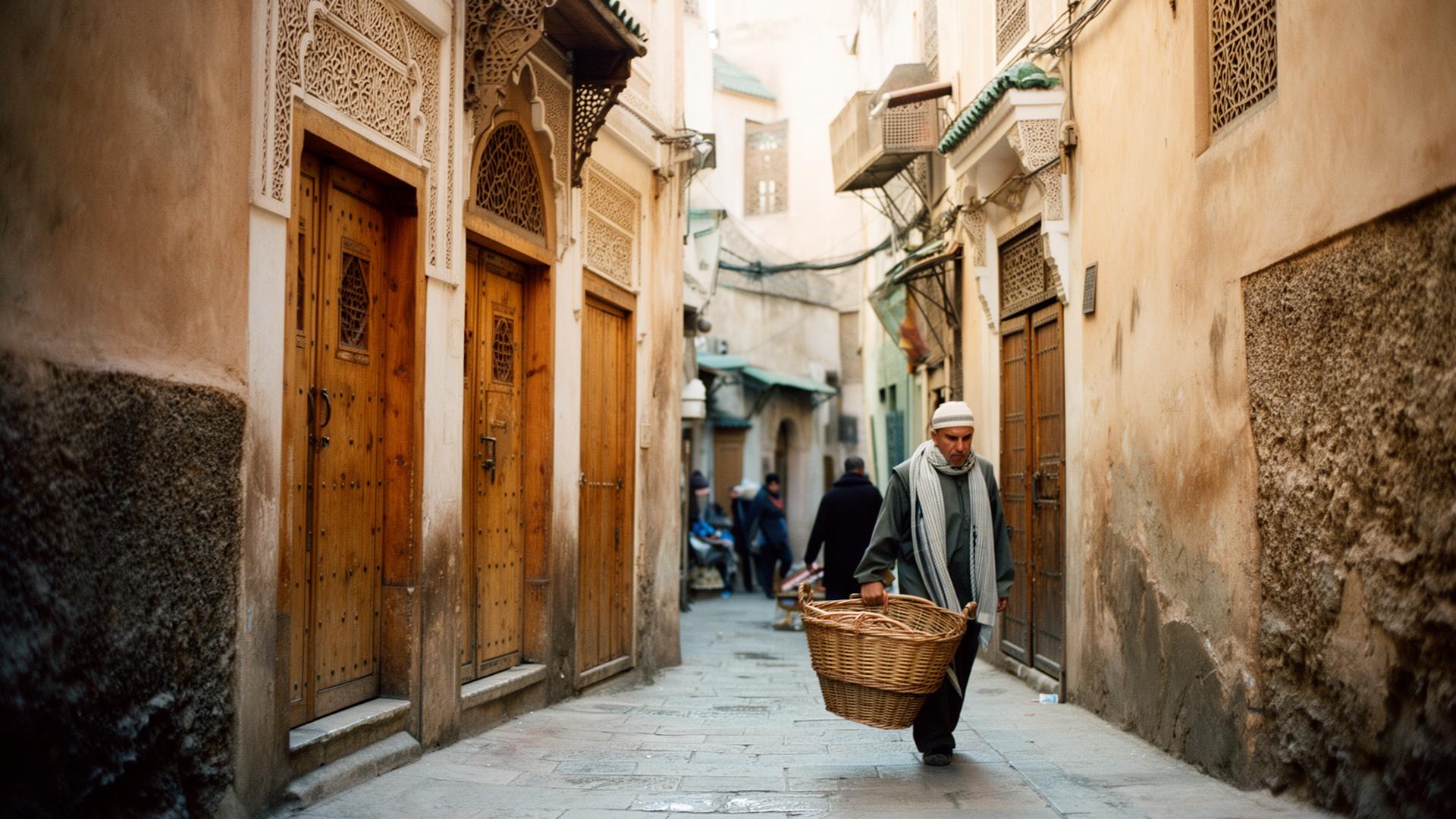
Fes el-Bali is the world's largest inhabited medieval city — a UNESCO World Heritage medina of 9,400 lanes, 14th-century madrasas, the planet's oldest university and the Chouara tanneries. It demands a good guide, unhurried time and genuine curiosity.
In this guide
What are the unmissable sights in Fes?
The Chouara tannery is Fes's most iconic image: a vast open-air complex of circular dyeing vats where leather has been processed in the same way since the 11th century. The best view is from the terraces of the surrounding leather shops (admission is usually free if you endure a brief sales pitch; a sprig of fresh mint, handed to you at the entrance, masks the smell). Morning is the optimal time — the workers are active and the light falls directly into the vats. The Bou Inania Madrasa, a few minutes' walk away, is the finest example of Marinid architecture in the country: carved cedarwood screens, intricate stucco and a muezzin clock tower that still chimes the call to prayer.
The University of al-Qarawiyyin — founded in 859 AD by Fatima al-Fihri and recognised by UNESCO as the world's oldest continuously operating university — is in the heart of the medina but closed to non-Muslims inside. Its main gate and the neighbourhood around it (the Qarawiyyin quarter) are remarkable to walk and understand. The Mellah, Fes's Jewish quarter, preserves a distinctive architecture of wrought-iron balconies and a beautiful synagogue; the Ibn Danan Synagogue is open to visitors.
- Chouara Tannery — view from leather shop terraces; arrive before 10am.
- Bou Inania Madrasa — Marinid masterpiece; the finest interior in Fes.
- Attarine Madrasa — ornate 14th-century school next to the Qarawiyyin.
- Musée Batha — regional museum of traditional art in a riad palace.
- Borj Nord — artillery fort with panoramic medina views from the hillside.
- Mellah and Ibn Danan Synagogue — Jewish quarter with a distinct architectural character.
- Merenid Tombs — ruined 14th-century tombs; best at sunset for cityscape views.
Why do you need a guide in Fes's medina?
Fes el-Bali is not a metaphor for labyrinthine complexity — it genuinely has 9,400 alleys, the majority of which are unnamed and unmapped on any digital service. Google Maps and similar tools are demonstrably wrong in significant portions of the medina. A licensed guide — and Fes has a well-established licensed guide association — is not a luxury here; it is the difference between a frustrating and a revelatory experience. A good guide navigates not just the lanes but the layers: the hidden foundouks (artisans' inns), the workshops behind unmarked doors, the neighbourhoods where residents rather than tourists live.
Licensed guides carry a government-issued badge and are regulated through the ONMT (Office National Marocain du Tourisme). The going rate for a half-day private city guide is approximately US$60–100. Guides arranged through your riad or a reputable agency are vetted; guides who approach you on the street near Bab Bou Jeloud are almost invariably unlicensed.
What crafts and workshops should you see in Fes?
Fes is Morocco's artisan capital in a meaningful way — several crafts have been produced here in an unbroken tradition since the medieval period, with workshops located in the same quarter of the medina they have occupied for centuries. The coppersmiths are concentrated near the Place Seffarine; you can watch intricate hammering of brass and copper trays in tiny workshops open to the lane. The carpenters' quarter (near the woodworkers' souk) still uses traditional lathe-turning techniques for cedarwood furniture and boxes.
The potters' quarter, Ain Nokbi, is across the medina to the south-east — largely overlooked by tourist itineraries but extraordinary for watching the making of Fassi blue-and-white ware from raw clay to finished glaze. The dyers' souk (Souk Sabbaghin) is a vivid spectacle of hanging skeins of freshly dyed wool in the narrow lanes near the tanneries.
- Place Seffarine — coppersmiths and brass workers; active from mid-morning.
- Ain Nokbi pottery quarter — Fassi ceramics production; rarely visited.
- Souk Sabbaghin — dyers' souk; vivid hanging skeins of silk and wool.
- Nejjarine Museum of Wooden Arts — fountain square and foundouk museum.
- Chez Rachid (leather tannery adjacent) — reputable leather shop with honest tannery-terrace access.
What are the best day trips from Fes?
Meknes, Morocco's less-visited imperial city, is 60 km from Fes and easily combined as a full-day excursion. The Bab Mansour gate is arguably the finest gate in Morocco; the royal granaries and stables are vast and atmospheric; the medina is relaxed and unhurried. The Roman ruins of Volubilis — one of the best-preserved in Africa, with floor mosaics, a triumphal arch and a colonnaded street — are 35 km north of Meknes and logically combined on the same day.
Chefchaouen, the famous blue city, is 4–5 hours' drive from Fes through the Rif Mountains — best as an overnight or two-night stay rather than a rushed day trip. Azrou cedar forest (2 hours south) is a half-day option, with Barbary macaque monkeys in the cedar trees and a refreshing contrast to the medina heat.
Where should you eat and stay in Fes?
The best dining in Fes is inside the riad palaces that operate restaurant services, often by reservation only. Riad Fes, Dar Roumana and Palais la Cigogne are consistently cited for their presentation of Moroccan haute cuisine in extraordinary architectural settings. For a casual lunch, the lanes around the Rcif quarter have small Moroccan restaurants serving set menus of soup, salad, tagine and dessert for 60–100 MAD — honest and good.
Riad accommodation in Fes ranges from simple guesthouses (MAD 400–800/night) to palace conversions with hammams, roof terraces and chef dinners. The medina addresses can be confusing for drivers — most riads provide a meeting point near one of the main gates (Bab Bou Jeloud or Bab Rcif) and walk you in. Book a riad that offers a guide service or introduction to their recommended licensed guides.
Frequently asked
How many days do you need in Fes?
Two full days is the minimum for the medina's highlights with a guide — the tanneries, the madrasas, the souks and the crafts quarter. Three days allows a day trip to Meknes and Volubilis and a slower pace in the medina lanes. Four days adds Chefchaouen or Azrou without feeling rushed.
What is Fes most famous for?
The Chouara tanneries, the medieval medina (Fes el-Bali), the Bou Inania Madrasa, the University of al-Qarawiyyin and the quality of its traditional leather and ceramic craftsmanship. Fes is Morocco's most architecturally intact imperial city and the one most rewarding for those interested in history and craft.
Is Fes safe to visit?
Yes — Fes is safe for tourists. The primary concern is getting lost in the medina without a guide and encountering unlicensed 'guides' offering to help who then demand payment. Use a licensed guide from the outset and the medina is a richly rewarding place to spend time.
How do you get from Marrakech to Fes?
By train: change at Casablanca; total journey roughly 7–8 hours. By private driver: via the Middle Atlas or the Ziz Valley, approximately 8–10 hours — a rewarding drive with scenic stops. By internal flight: Air Arabia Morocco connects the two cities in about an hour, departing from Marrakech Menara (RAK) and arriving at Fes-Saïss (FEZ).
What is the best time to visit the Fes tanneries?
The tanneries are most active in the morning — arriving before 10am gives you workers moving hides between vats and the best light. By early afternoon, activity slows and some vats sit empty. The traditional dyeing season (when the vats hold the most vivid colour) runs from autumn through spring.
Planning a trip?
Let a Marrakech atelier handle the details.
Tell us your dates and style and we'll send a written itinerary and a transparent quote within 24 hours.
Request an itineraryKeep reading
Planning
The Best Time to Visit Morocco
Spring (March–May) and autumn (September–November) are the best all-round times to visit Morocco — warm days, cool evenings and ideal conditions for the medinas, mountains, coast and desert alike.
Itineraries
Morocco Itinerary: 7 Days
A week is enough to pair Marrakech with the Sahara, or to trace the imperial cities of the north. Here are two proven 7-day Morocco itineraries — and how to choose between them.
Itineraries
Morocco Itinerary: 10 Days
Ten days is the sweet spot for Morocco — long enough to combine Marrakech, the Sahara and the imperial north in one unhurried loop, with the coast as an optional finish.
Planning
Things to Do in Chefchaouen: The Essential Guide
Chefchaouen — Morocco's famous blue city tucked into the Rif Mountains — is more than a photography backdrop. Its medina is small, walkable and genuinely beautiful; its mountains reward hikers; its food is distinctively Rifian; and its pace is the slowest in the country.