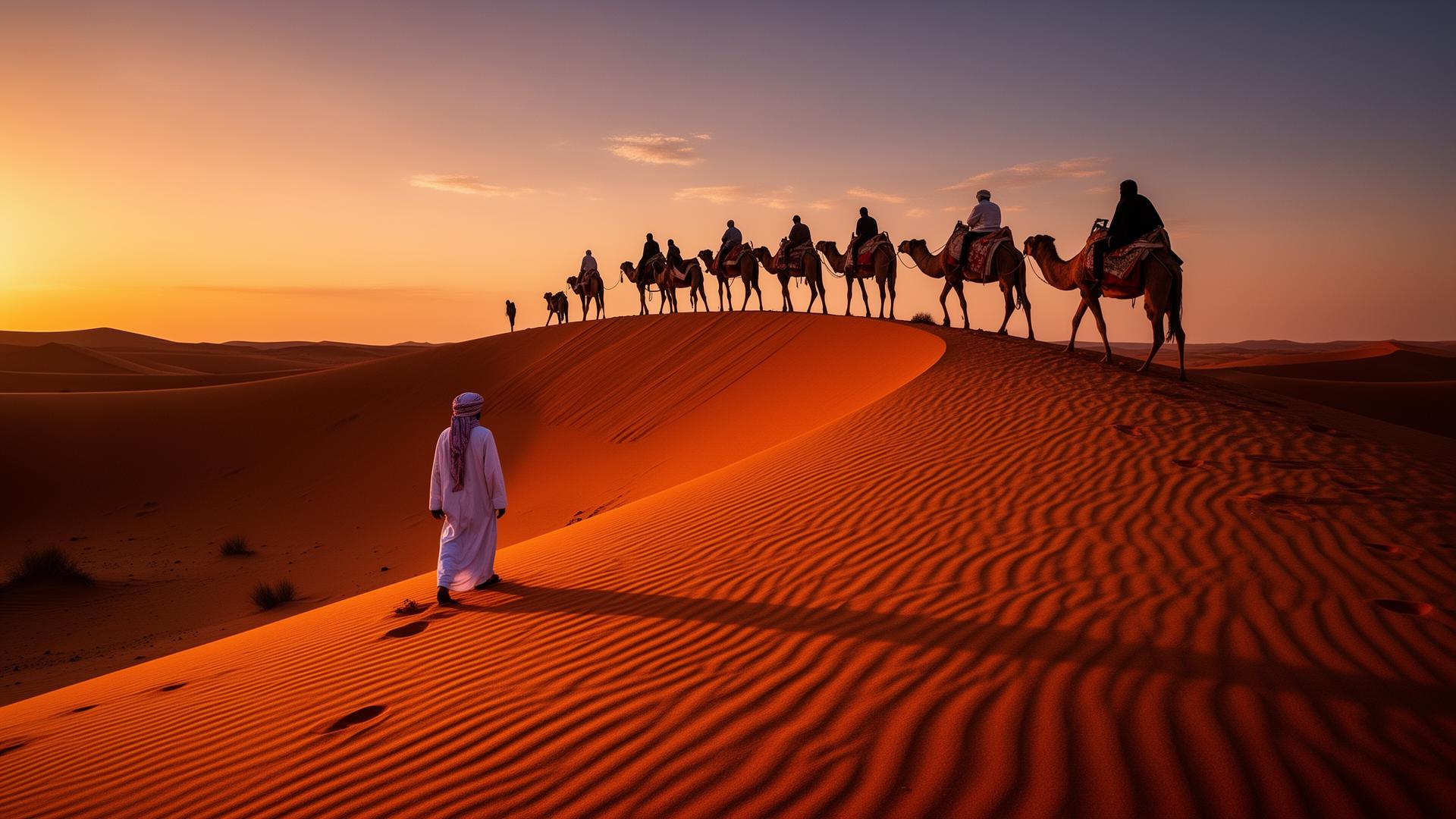
Ouarzazate — 'the door of the desert' — sits at the junction of the High Atlas and the Saharan south. It is the gateway to Aït Ben Haddou, Africa's most famous film set, and the Drâa Valley; its Atlas Studios produce more major films than almost anywhere outside Hollywood.
In this guide
What is Aït Ben Haddou and how do you visit it?
Aït Ben Haddou — a UNESCO World Heritage ksar (fortified earth-brick village) 30 km north-west of Ouarzazate — is the most photographed historic site in southern Morocco. The ksar's six family towers (ighrem) rise from a rocky promontory above the Ounila river in a sequence of tapering pisé walls, crenellated towers and carved geometric decoration that has appeared on film and television with extraordinary frequency: Gladiator, Lawrence of Arabia, The Mummy, Game of Thrones (seasons 3–4 as Yunkai and later Meereen), The Last Temptation of Christ and dozens more have been filmed here.
Cross the river on foot (stepping stones in the dry season; a footbridge in high water) and climb through the inhabited lower village and the uninhabited upper ksour. The view from the granary (agadir) at the summit — across the river, the palm oasis, the Ounila plain and the Atlas beyond — is one of the great panoramas of Morocco. Entry to the ksar is free; guides (MAD 80–120) are available at the base of the crossing and are worthwhile for context. Allow 2–3 hours for a thorough visit.
- Aït Ben Haddou ksar — UNESCO World Heritage pisé village; view from the summit granary.
- Film set background: Gladiator, Game of Thrones, Lawrence of Arabia, The Last Temptation of Christ.
- River crossing — stepping stones in dry season; footbridge at other times.
- Local guides available at the base: MAD 80–120.
- Adjacent new village — small restaurant strip; argan oil and artisan shops.
What is the Atlas Studios and can you visit it?
Atlas Studios — the largest film studio in Africa and one of the largest in the world by land area — is located 6 km north of Ouarzazate. Founded in 1983 by Mohammed Belghmi, it has hosted Bernardo Bertolucci's The Sheltering Sky, Martin Scorsese's Kundun, Ridley Scott's Gladiator, Oliver Stone's Alexander, and more recently international television productions. The permanent sets — a recreation of ancient Egypt, Moroccan medina streets, Roman forums, a Tibetan monastery — are left standing between productions and can be visited on a guided tour.
Tours run from around 8:00 to 17:00 daily (closed Friday mornings) and cost approximately MAD 80 per adult. The experience is at once slightly surreal and genuinely interesting: walking through the ancient Egyptian set and then turning a corner into the Moroccan village from a TV production illustrates the remarkable range of landscapes the Ouarzazate region can convincingly represent.
What is the Taourirt Kasbah and what else is there to see in Ouarzazate itself?
The Taourirt Kasbah — the former palace of the Glaoui feudal lords who controlled the southern passes of the Atlas in the late 19th and early 20th century — stands in the centre of Ouarzazate. Dating from the 18th century and expanded by Thami El Glaoui (the Pasha of Marrakech who was a controversial figure of the French Protectorate era) it is one of the best-preserved kasbahs in Morocco. The interior, partially restored by UNESCO, displays Glaoui-era furnishings, painted woodwork and the administrative rooms of a lord who commanded the routes to the Sahara. Entry is approximately MAD 20.
The Fint Oasis — a lush palm grove 6 km south of the city in a dry river valley — makes a striking contrast to the surrounding desert plateau. A 30-minute drive and then a short walk brings you to a world of running irrigation channels, date palms, oleander and Berber garden plots. The sunrise visit (or very early morning in summer) catches the soft light on the pink earth walls of the narrow canyon. Camel rides and walks through the oasis are available from local operators.
- Taourirt Kasbah — 18th-century Glaoui palace; UNESCO-restored interior; entry MAD 20.
- Fint Oasis — 6 km south; palm grove in a desert canyon; best at sunrise or late afternoon.
- Musée du Cinéma — small cinema museum in the city centre documenting the film industry.
- Drâa Valley road south — the palm-lined valley road to Zagora is one of Morocco's most beautiful drives.
What day trips can you do from Ouarzazate?
The Drâa Valley — Morocco's longest river valley, stretching 200 km south from Ouarzazate towards Zagora — is one of the country's most spectacular landscapes: a continuous palm oasis cutting through black hammada desert, punctuated by hilltop kasbahs and Berber villages. The drive to Zagora (2.5 hours) passes Agdez, the Tamnougalt ksar and the palmery of Tinzouline. Zagora itself is a departure point for shorter Sahara excursions to the dunes of Erg Lihoudi.
The Skoura Oasis — 45 km north-east of Ouarzazate on the road towards the Dadès Valley — contains the finest concentration of kasbahs in Morocco: dozens of Glaoui-era pisé towers rising from a dense date-palm oasis. The most significant is the Amridil Kasbah (MAD 30 entry), still inhabited by its original family and in remarkable condition. A walk through the palmery takes 2–3 hours and can be combined with a visit to the Dadès Gorge (70 km further east).
- Drâa Valley to Zagora — 2.5 hrs south; continuous palm oasis; hilltop kasbahs and the Erg Lihoudi dunes.
- Skoura Oasis — 45 km east; Morocco's finest kasbah concentration; Amridil Kasbah open to visitors.
- Dadès Gorge — 2 hrs east; dramatic red rock canyon; good base for Atlas trekking.
- Todra Gorge — 3 hrs east; 300 m vertical limestone walls; rock climbing and walking.
How do you get to Ouarzazate and where do you stay?
The Tizi n'Tichka pass — the highest paved road in Morocco at 2,260 m — connects Marrakech to Ouarzazate in approximately 3.5–4 hours by private car. The drive is spectacular: switchback hairpins rising through the High Atlas, with views of snow-capped peaks in winter and early spring, descending through Berber villages and argan forests into the Saharan south. Royal Air Maroc operates domestic flights between Marrakech and Ouarzazate (Moulay Ali Cherif Airport, OZZ) when schedules align, but the drive is the more rewarding approach.
Accommodation in Ouarzazate ranges from basic guesthouses to several genuinely good hotels with pool and kasbah views, useful as a staging point for multi-day desert loops. The Berbère Palace and Dar Ahlam (the latter 30 km east in the Skoura palmery, one of the finest boutique hotels in Morocco) represent the top end. Most visitors stay one or two nights, typically as part of the Marrakech–desert–Fes loop.
Frequently asked
Why is Ouarzazate called the door of the desert?
Ouarzazate sits at the southern edge of the High Atlas, at the point where the mountain passes give way to the Saharan pre-desert and the Drâa Valley palm oases. It is the last significant town before the landscape becomes definitively desert, and the departure point for the Sahara routes east towards Merzouga and south towards Zagora — hence its traditional name, 'the door of the desert'.
How far is Aït Ben Haddou from Ouarzazate?
Approximately 30 km north-west, about 30–40 minutes by car. It is a standard half-day excursion combined with the drive over the Tizi n'Tichka pass from Marrakech. Most visitors stop at Aït Ben Haddou en route to Ouarzazate rather than making a separate trip.
What films were shot in Ouarzazate?
The Ouarzazate region — including Atlas Studios, Aït Ben Haddou and the surrounding desert — has been used for Gladiator (2000), Lawrence of Arabia (1962), The Last Temptation of Christ (1988), The Sheltering Sky (1990), Kundun (1997), Alexander (2004), and Game of Thrones (seasons 3–4). The variety of desert and kasbah landscapes allows the region to double convincingly for ancient Egypt, Arabia, ancient Rome and sub-Saharan Africa.
Is Ouarzazate worth visiting without going to the Sahara?
Yes. Aït Ben Haddou, the Atlas Studios tour, the Taourirt Kasbah and the Drâa Valley are individually worthwhile, and the Fint Oasis and Skoura palmery add further reasons to linger. That said, Ouarzazate's greatest value is as a staging point for the Sahara loop; travellers who stop only for the day and push on to Merzouga make the best use of it.
What is the best time to visit Ouarzazate?
Spring (March–May) and autumn (September–November) are ideal: moderate temperatures (18–26°C), comfortable for walking Aït Ben Haddou and exploring the palmeries. Summer (July–August) is very hot (35–40°C); early-morning and late-afternoon visits are manageable but the middle of the day is punishing. Winter is cool and sunny (10–18°C) with possible snow on the Tizi n'Tichka, which can occasionally close the pass; check road conditions if travelling in December–February.
Planning a trip?
Let a Marrakech atelier handle the details.
Tell us your dates and style and we'll send a written itinerary and a transparent quote within 24 hours.
Request an itineraryKeep reading
Planning
Things to Do in Marrakech: The Essential Guide
Marrakech is sensory overload in the best possible way — a medieval medina, world-class gardens, hammam rituals, rooftop dinners and a square that transforms nightly into one of the world's great open-air spectacles. Here is where to spend your time.
Itineraries
Morocco Itinerary: 7 Days
A week is enough to pair Marrakech with the Sahara, or to trace the imperial cities of the north. Here are two proven 7-day Morocco itineraries — and how to choose between them.
Itineraries
Morocco Itinerary: 10 Days
Ten days is the sweet spot for Morocco — long enough to combine Marrakech, the Sahara and the imperial north in one unhurried loop, with the coast as an optional finish.
Planning
The Best Time to Visit Morocco
Spring (March–May) and autumn (September–November) are the best all-round times to visit Morocco — warm days, cool evenings and ideal conditions for the medinas, mountains, coast and desert alike.