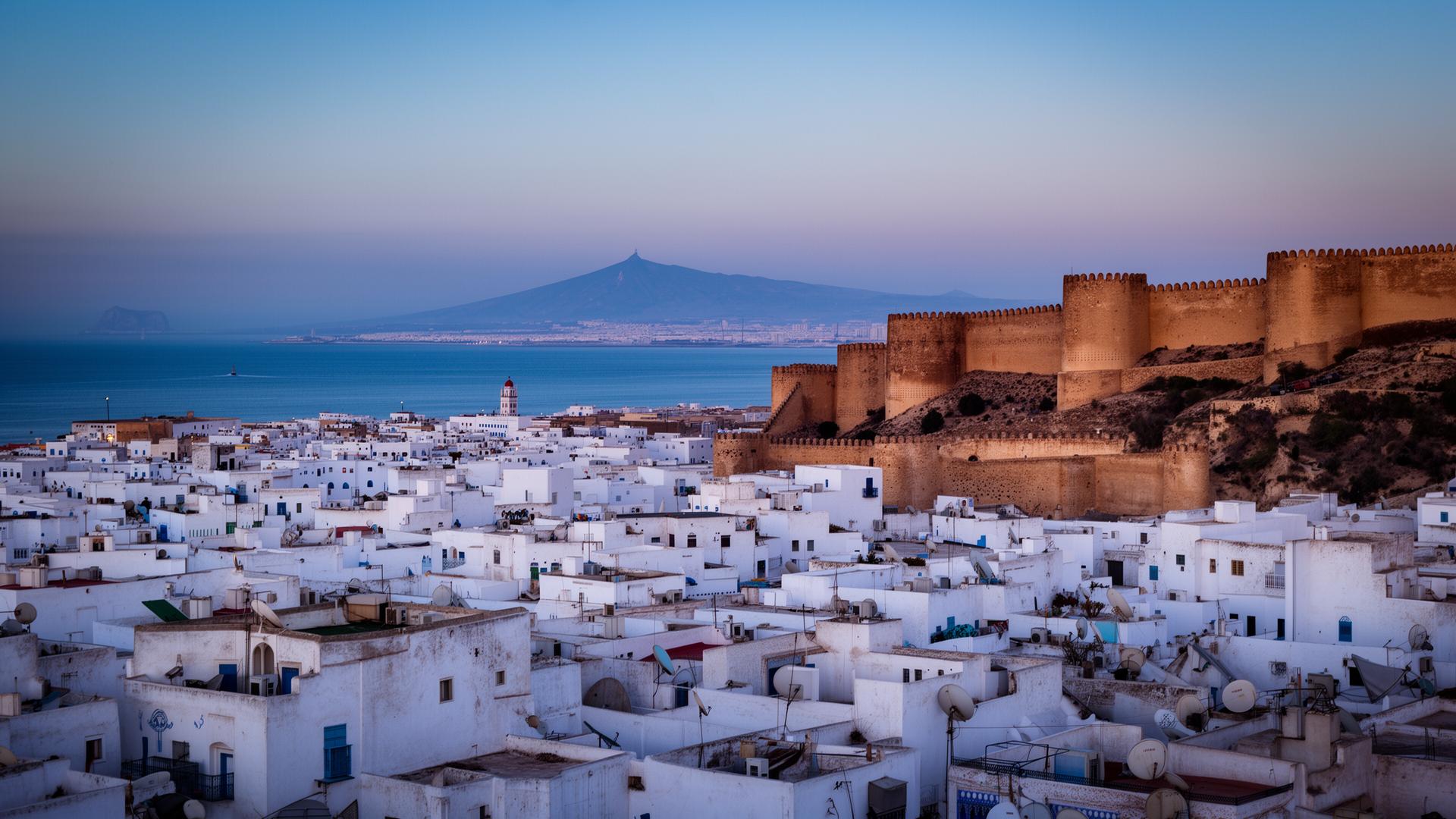
Chefchaouen and Tangier are the two northern stops most travellers weigh against each other, and they could hardly be more different in temperament. Chefchaouen sits high in the Rif mountains, its compact medina washed in soft blues from cobalt to powder, its lanes quiet enough to hear the wind in the surrounding cedar and pine. It rewards a slow pace: a coffee on Outa el-Hammam square, a walk up to the Spanish Mosque viewpoint, a half-day hike to the Akchour waterfalls. Tangier, roughly 110 km north on the Strait of Gibraltar, is a city of a different order entirely — a working port and ferry hub where Spain is visible across the water, a place with a layered cosmopolitan past that drew writers and artists through the 20th century. Its restored medina, the Kasbah quarter, the Grand Socco and the Atlantic-facing Cap Spartel all reward exploration, but the rhythm is urban, not restful.
Option A
Chefchaouen
The Blue Pearl of the Rif — calm, photogenic, mountain-fresh
Best for
Photographers, slow travellers, walkers wanting a peaceful mountain base
Full guideOption B
Tangier
Morocco's gateway port — cosmopolitan, literary, where two seas meet
Best for
City lovers, history and culture seekers, those arriving from or heading to Spain
Full guideSide-by-side breakdown
Chefchaouen vs Tangier: how they compare
| Category | Chefchaouen | Tangier |
|---|---|---|
| Character | Tranquil Rif mountain village; compact blue-washed medina at around 600 m | Cosmopolitan port city on the Strait of Gibraltar; layered international past |
| Setting | High in the Rif mountains, surrounded by forested slopes | Where the Mediterranean meets the Atlantic; Spain visible across the strait |
| Iconic sight | Outa el-Hammam square; the Spanish Mosque viewpoint; Ras el-Ma stream | Kasbah and Dar el-Makhzen; Grand Socco; Cap Spartel and the Caves of Hercules |
| Pace | Slow and restful — easily explored on foot in a day or two | Busier and more urban; a working port with the buzz of a transit hub |
| Getting there | No airport; reached by road — roughly 2 h from Tangier, 1.5 h from Tetouan | Tangier Ibn Battouta Airport (TNG); trains to Casablanca and Rabat; ferries from Spain |
| Time needed | 1–2 nights is usually enough; add a night for the Akchour gorge hike | 1–2 days for the medina, Kasbah and Cap Spartel; longer if using it as a base |
| Day trips & onward links | Akchour waterfalls; Talassemtane National Park; Tetouan | Asilah (around 45 min); Cap Spartel; ferry day-link to Tarifa in Spain |
| Food & scene | Simple and good — Rif goat cheese, tagine, fresh bread; relaxed café terraces | Broader range — fresh seafood on the port, Spanish-influenced dishes, lively cafés |
Our verdict
Which should you choose?
Choose Chefchaouen if you want calm, mountain air and one of the most photogenic medinas anywhere — it is the place to slow down and walk. Choose Tangier if you want a cosmopolitan city with history, a sea-meeting-sea setting and easy onward links by air, train or ferry. For most northern itineraries the two pair naturally rather than compete: many travellers arrive in Tangier (often from Spain), spend a day or two on the strait, then drive up into the Rif to unwind in Chefchaouen before continuing to Fes. Doing both, in either order, is usually the better answer than choosing one.
Deep dives
Explore each destination in full
FAQ
Frequently asked questions
How far is Chefchaouen from Tangier?
Chefchaouen is roughly 110 km from Tangier — generally about 2 to 2.5 hours by road. CTM and other buses run the route daily, and shared grand taxis are also common. There is no train or direct flight between the two.
Is it better to base yourself in Tangier or Chefchaouen?
It depends on your priorities. Tangier works well as a transport base, with an airport, train links and ferries to Spain, and more to do in the evenings. Chefchaouen is the better base for a restful, scenic stay and mountain walks. Many travellers spend a night or two in each rather than choosing.
Why is Chefchaouen painted blue?
There are several explanations and no single agreed answer. A widely cited one links the blue to the Jewish community that settled here, associating the colour with the sky and spirituality; other accounts suggest practical reasons such as keeping interiors cool or deterring insects. Whatever the origin, residents have maintained and expanded the tradition, and the medina is regularly repainted.
What is Tangier known for?
Tangier is known for its position on the Strait of Gibraltar where the Mediterranean meets the Atlantic, its long cosmopolitan history as an international city that drew writers and artists, and sights such as the Kasbah quarter, the Grand Socco, and nearby Cap Spartel and the Caves of Hercules. It is also a major ferry and transport gateway between Morocco and Spain.
Can I visit both Chefchaouen and Tangier in one trip?
Yes, and it is a common pairing. A popular northern circuit arrives in Tangier — often by ferry from Spain — spends a day or two there and at nearby Asilah, then heads into the Rif to Chefchaouen for a night or two before continuing south to Fes. The short drive between them makes combining the two straightforward.
Ready to book?
Let a Marrakech atelier build your itinerary.
Tell us which destinations you want to combine and we'll send a written itinerary and a transparent quote within 24 hours.
Keep comparing
All destination comparisons