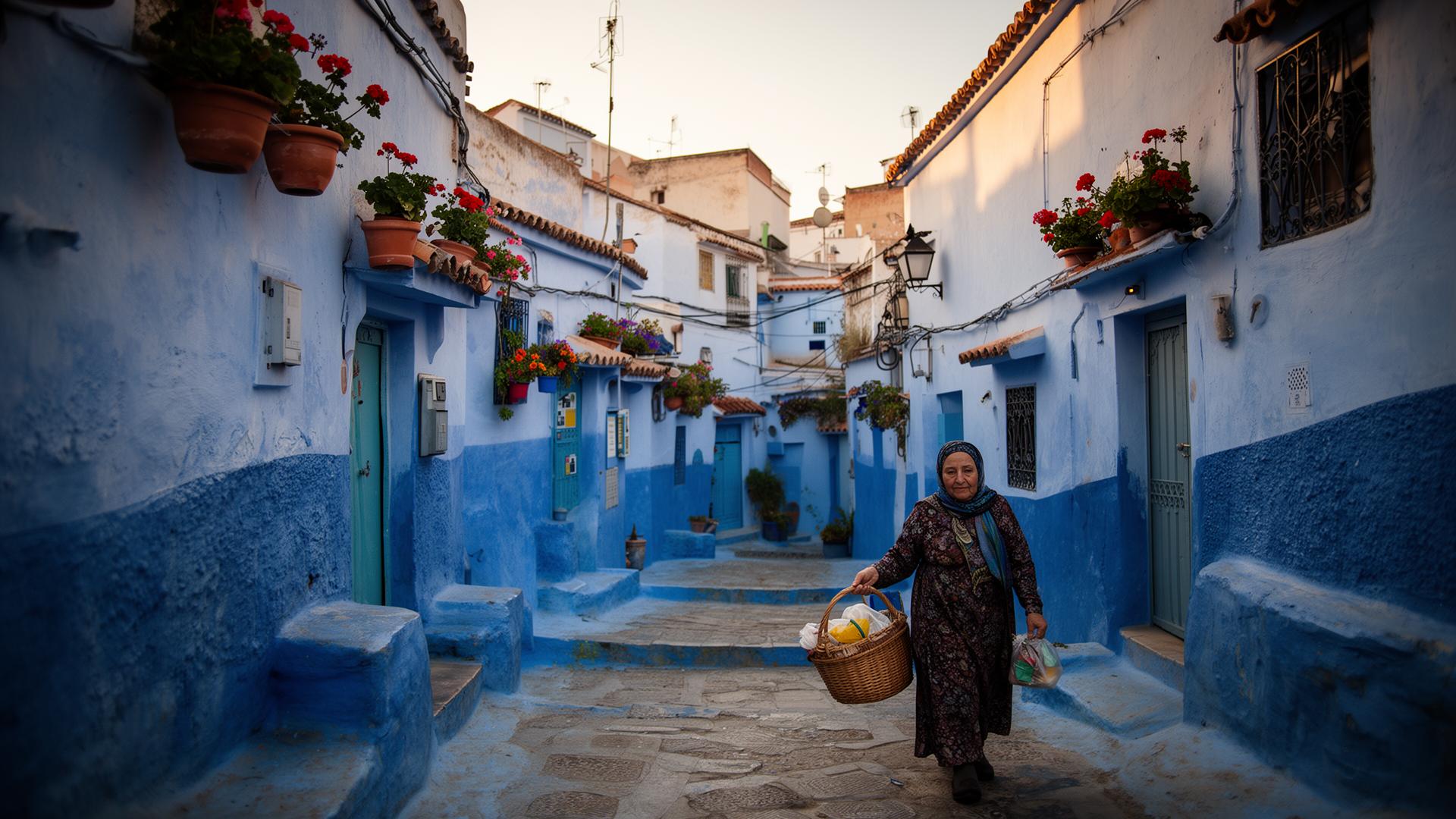
Northern Morocco is a different country from the south — Andalusian and Mediterranean, green and mountainous, with whitewashed and blue towns rather than red kasbahs. This guide covers Tangier the cosmopolitan strait city, blue Chefchaouen in the Rif, UNESCO Tetouan, seaside Asilah, the Rif mountains and Akchour waterfalls, the Mediterranean coast at Al Hoceima, and the ferry link to Spain — with character, how to string them together, and the best season to go.
In this guide
A different Morocco
The north feels distinct from the imperial heartland and the Saharan south. Centuries of Andalusian influence — Muslims and Jews who crossed from Spain — and a long Spanish colonial presence (this was the Spanish Protectorate, separate from the French zone) left a region of whitewashed houses, tiled fountains, Spanish loanwords and a Mediterranean tempo. The landscape is greener and more mountainous, dominated by the Rif, and the light is softer and cooler than the desert glare further south.
It is also less travelled than the Marrakech–Sahara circuit, which is part of its appeal. You can build a satisfying week here alone, or bolt the north onto a longer trip via Fes, which sits at the southern edge of the region and is the natural gateway by train.
Tangier: the city of the strait
Tangier guards the Strait of Gibraltar where the Atlantic meets the Mediterranean, and you can see Spain across the water on a clear day. Long a free-wheeling 'International Zone' that drew writers and artists (Bowles, Burroughs, Matisse), it has been smartened up considerably in recent years, with a revived marina, corniche and renovated kasbah. Wander the compact medina and kasbah, take in the view from the Café Hafa, and visit Cap Spartel and the Caves of Hercules just west of the city.
Tangier is the north's transport hub: the Al Boraq high-speed train links it to Rabat and Casablanca in a couple of hours, and the ferry port (technically Tanger Med, east of the city) connects to Spain. It makes a logical start or end point for a northern loop.
Chefchaouen: the blue city in the Rif
Chefchaouen — 'Chaouen' to locals — is the famous blue-washed town tumbling down a fold of the Rif mountains. Its lanes, painted in countless shades of blue, are deservedly one of Morocco's most photographed sights, and the mountain setting keeps it cool and walkable. The small medina is gentle and low-pressure compared with Fes or Marrakech, the Plaza Uta el-Hammam is a fine place to sit, and the climb to the Spanish Mosque above town rewards you with a sunset panorama.
It is busiest in the middle of the day when tour groups arrive; stay overnight to have the blue lanes to yourself in the early morning and evening. Chaouen is also the trailhead for the Rif's best walking.
Tetouan and Asilah
Tetouan, the former capital of the Spanish Protectorate, has a UNESCO-listed medina that is among the most complete and authentically Andalusian in Morocco — whitewashed, intricate and far less touristed than Fes. The Spanish-built ensanche (new town) and a strong craft tradition add to its character, and it is an easy hop from Chefchaouen.
On the Atlantic side, Asilah is a small, immaculate walled town of whitewashed houses and Portuguese-era ramparts, famous for the murals painted across its medina walls during its summer arts festival. It is relaxed, photogenic and good for a slow day or two by the sea, an easy detour between Tangier and the south.
- Tetouan: UNESCO Andalusian medina, Spanish ensanche, strong crafts — uncrowded.
- Asilah: whitewashed ramparts, painted murals, calm Atlantic seaside town.
The Rif mountains: Akchour and Talassemtane
The Rif is the green, rugged mountain range that defines the north. The most popular walk is in the Akchour area near Chefchaouen, where a streamside trail leads to a series of waterfalls and, on a longer route, to the natural rock arch known as God's Bridge (Pont de Dieu). It is a rewarding day out, busy on summer weekends; wear proper shoes as the path is rocky and can be slippery.
Above and around it lies Talassemtane National Park, a higher, wilder landscape of Moroccan fir forest and limestone gorges for those wanting longer hikes with a local guide. A practical note: the wider Rif is also Morocco's cannabis-growing region, and around the town of Ketama in particular travellers are sometimes approached — it is best to keep to the established walking areas around Chefchaouen and Akchour and politely decline any offers.
Al Hoceima and the Mediterranean coast
East along the Mediterranean, Al Hoceima is the north's beach town, set among rocky coves and a small national park, with some of the cleanest swimming water on this coast. It is more of a Moroccan summer-holiday destination than an international tourist stop, which is part of its low-key charm. It sits further off the main circuit, so it suits those with more time or their own transport.
The ferry to Spain
The north is the crossing point to Europe. Fast ferries link Morocco to Spain across the strait — principally from Tanger Med (the large port east of Tangier) and from the Spanish enclave of Ceuta to Algeciras and Tarifa, with the Tarifa route landing closest to Tangier's centre. Crossings take roughly an hour to ninety minutes depending on the route. It makes a memorable way to arrive or leave, and pairs Morocco neatly with Andalusia.
How to string it together and when to go
A natural loop runs Tangier → Asilah → Tetouan → Chefchaouen, with Akchour as a day walk from Chaouen, then back to Tangier or south by train to Fes; add Al Hoceima only if you have extra days. Four to six days covers the core comfortably. Distances are short but the roads are winding and mountainous, so build in slack.
Spring (April–June) and early autumn (September–October) are ideal — green hills, wildflowers and comfortable walking weather. Summer is busy and hot on the coast but pleasant up in Chefchaouen. Winter is mild but wet, and the Rif can be genuinely cold and grey, with cloud often sitting on the mountains.
Frequently asked
How many days do you need in northern Morocco?
Four to six days covers the core loop of Tangier, Asilah, Tetouan and Chefchaouen comfortably, with a day for the Akchour waterfalls from Chaouen. Add a couple more if you want to reach Al Hoceima on the Mediterranean coast, which sits further off the main circuit.
Is Chefchaouen worth visiting?
Yes — the blue-washed town in the Rif is genuinely beautiful and far more relaxed than the big imperial medinas, with a cool mountain setting and excellent walking nearby. Stay overnight to enjoy the lanes in the early morning and evening, after the midday tour groups have left.
Is northern Morocco safe to visit?
The tourist towns of the north — Tangier, Chefchaouen, Tetouan, Asilah — are safe and welcoming, with the usual city common sense around petty theft. The one local caveat is that the wider Rif is a cannabis-growing area, and around Ketama travellers are sometimes approached; keep to the established walking areas near Chefchaouen and Akchour and decline any offers.
Can you take a ferry from northern Morocco to Spain?
Yes. Fast ferries cross the Strait of Gibraltar from Tanger Med (the port east of Tangier) and from Ceuta to Algeciras and Tarifa, the Tarifa route being closest to central Tangier. Crossings take roughly one to one and a half hours and make an easy link with Andalusia.
Planning a trip?
Let a Marrakech atelier handle the details.
Tell us your dates and style and we'll send a written itinerary and a transparent quote within 24 hours.
Request an itineraryKeep reading
Planning
Things to Do in Chefchaouen: The Essential Guide
Chefchaouen — Morocco's famous blue city tucked into the Rif Mountains — is more than a photography backdrop. Its medina is small, walkable and genuinely beautiful; its mountains reward hikers; its food is distinctively Rifian; and its pace is the slowest in the country.
Planning
Things to Do in Tangier: The Essential Guide
Tangier has transformed from the faded, slightly edgy gateway it was for decades into one of Morocco's most interesting cities — its kasbah restored, its seafront rebuilt, and its literary history as a city of expatriate writers and artists consciously reclaimed.
Planning
Morocco by Region: How to Choose Where to Go
Morocco packs imperial cities, high mountains, the Sahara and two coastlines into one country. This region-by-region overview helps you decide where to focus, since no single trip can cover it all comfortably.
Planning
Best Time to Visit Chefchaouen: Season, Weather & Practical Tips
Chefchaouen is beautiful year-round, but spring (March–May) and autumn (September–October) deliver the best combination of mild weather, manageable crowds and perfect light for the city's famous blue-washed medina. Here is what each season brings.