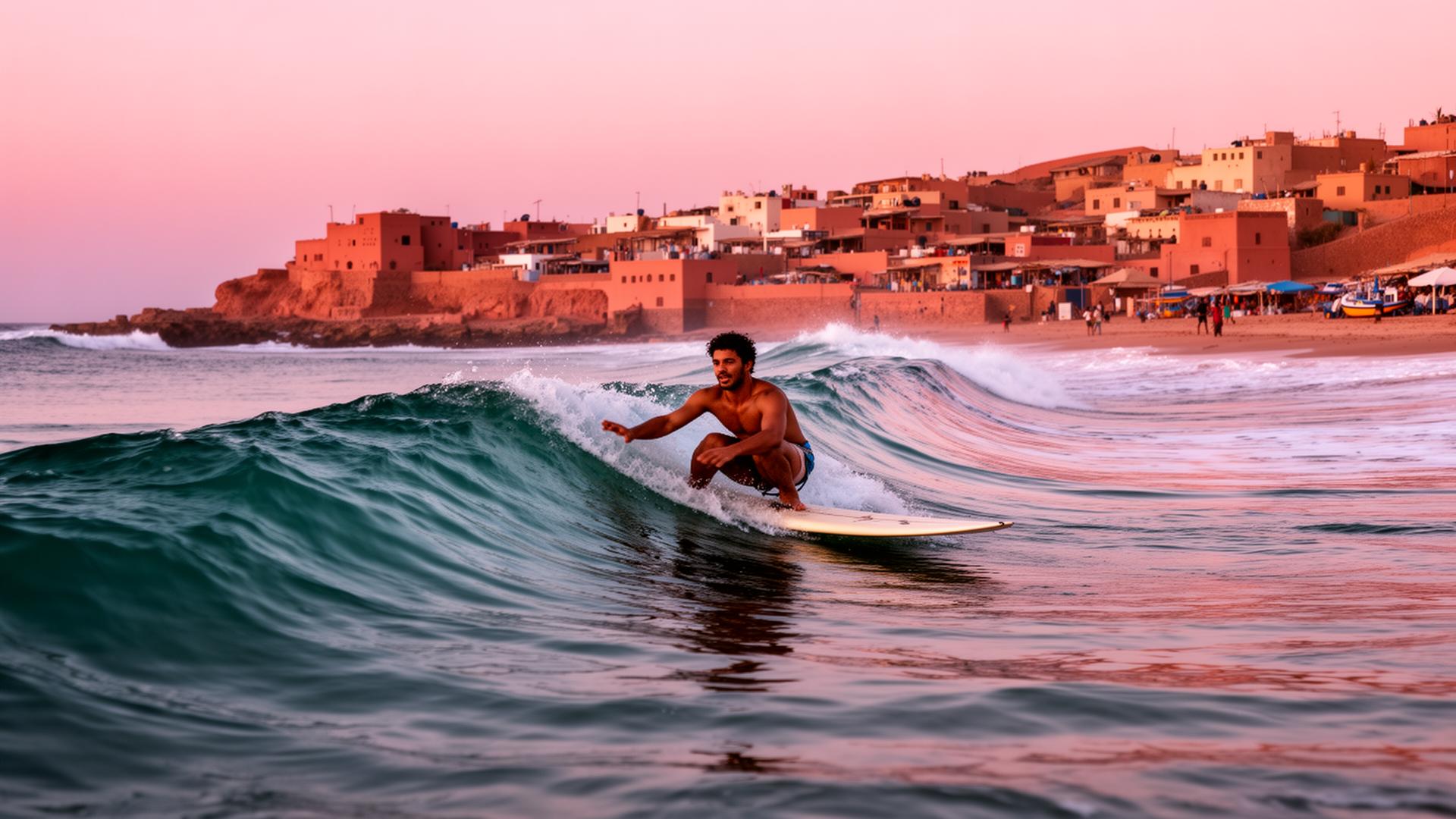
Morocco has quietly become one of the more popular remote-work bases in the region — warm, affordable, well-connected to Europe by a one-hour time difference, and with a surf-and-coworking scene anchored by Taghazout plus city bases in Marrakech, Essaouira, Tangier and Agadir. Here's how to work remotely or settle in for a long stay: the bases, connectivity and mobile data, the realities of visas and extensions, cost of living, and what daily life is actually like.
In this guide
Why Morocco works for remote work
For anyone working off a laptop, Morocco's appeal is a mix of practical advantages: it sits in roughly the same time zone as the UK and only an hour behind most of continental Europe, so client calls and team hours line up cleanly. It's a short, cheap flight from many European cities, the cost of living is moderate, and the climate is mild for much of the year.
On top of that there's lifestyle: surf on the Atlantic, mountains and desert within reach for weekends, a deep café culture, and cities that range from buzzing (Marrakech) to laid-back (Essaouira). It is not a frictionless, fully set-up digital-nomad machine like some Southeast Asian hubs — infrastructure and bureaucracy take patience — but as a base it is genuinely workable and increasingly well-trodden.
- Time zone: Morocco runs on GMT, shifting to GMT+1 for part of the year — broadly aligned with the UK and an hour behind much of Europe.
- Short-haul flights to Europe, moderate living costs and a strong café culture.
- Weekends within reach: surf coast, High Atlas, Sahara and the imperial cities.
The popular bases
Where you settle shapes the whole experience. Taghazout, on the Atlantic coast north of Agadir, is the de facto surf-and-coworking capital — a small village turned remote-work magnet with dedicated coworking spaces, surf camps, café Wi-Fi and an easy international crowd. Nearby Agadir adds the infrastructure of a proper city: an airport, supermarkets, gyms and long beaches.
Marrakech is the big-city option — the most connected airport, the widest choice of apartments, riads, cafés and coworking, and the most going on, balanced against heat in summer and the intensity of the medina. Essaouira is the mellow coastal alternative: walkable, breezy, creative and calm, though smaller and quieter. Tangier, facing Spain across the strait, is cosmopolitan and well-connected to Europe, with a growing café and coworking scene.
- Taghazout — surf, coworking and a ready-made nomad community; small and seasonal.
- Agadir — modern city infrastructure and beaches, a short hop from Taghazout.
- Marrakech — the most connected, busiest base; hot in summer, lots of housing and cafés.
- Essaouira — calm, walkable, creative coastal town; quieter and smaller.
- Tangier — cosmopolitan, European-facing, with a rising café and coworking scene.
Coworking spaces and café Wi-Fi
The main bases all have dedicated coworking spaces offering day passes and monthly memberships, fast wired or Wi-Fi connections, meeting rooms and a built-in community — Taghazout, Marrakech and increasingly Tangier and Agadir are the strongest for this. Surf-and-co-work camps around Taghazout bundle accommodation, a desk and surf into one package, which is an easy soft landing for a first stay.
Beyond formal coworking, café culture is everywhere and many cafés are happy for you to work for the price of a coffee or two — though Wi-Fi quality is hit-and-miss, so it pays to have mobile data as a backup. For anything connection-critical (live calls, large uploads), a coworking space or a tested apartment connection is more reliable than café Wi-Fi.
- Day passes and monthly memberships are widely available in the main bases.
- Surf-and-co-work camps near Taghazout bundle a desk, a bed and surfing.
- Café Wi-Fi is common but variable — keep mobile data as a fallback.
Mobile data and staying connected
Mobile data is cheap and central to staying online here. A local prepaid SIM from one of the main operators is inexpensive and easy to top up, with data bundles that cost a fraction of European rates; an eSIM is a convenient alternative if your phone supports it and you'd rather sort connectivity before you land. Bring an unlocked phone either way.
Coverage is good 4G — and increasingly 5G — across the cities and main towns, which is more than enough for calls, video meetings and tethering a laptop. It thins out in rural areas, the mountains and the deep desert, where you should expect patchy or no signal. Many remote workers run a local data SIM as their primary connection and treat home or café Wi-Fi as a secondary, which sidesteps a lot of unreliable-Wi-Fi frustration.
- A cheap local prepaid SIM (or an eSIM) gives generous data for a fraction of European prices.
- Solid 4G/5G in cities and main towns; patchy to none in rural, mountain and desert zones.
- Tethering off mobile data is a reliable backup for calls and big uploads — bring an unlocked phone.
Visas, length of stay and extensions
This is the part to research carefully and from official sources, because it varies by nationality and changes over time. As a general pattern, many nationalities (including most of Europe, the UK, the US, Canada and Australia) can enter Morocco visa-free for tourism for up to 90 days. That makes a stay of up to three months straightforward for many travellers — but you must confirm your own nationality's rules before you book.
Staying beyond the visa-free window is where it gets less clear-cut. In principle you can apply for an extension at a local police station (the relevant authority), but the process can be bureaucratic and outcomes are not guaranteed; some long-stayers instead do a "border run" — leaving the country and re-entering to reset the clock — though this is informal, not a guaranteed right, and shouldn't be relied on as a long-term strategy. Morocco has also discussed and developed longer-stay and residency pathways over time. Treat all of this as changeable: verify the current rules, extension procedures and any visa or residence options with official Moroccan government sources or a Moroccan consulate before relying on them.
- Common pattern: many nationalities enter visa-free for tourism for up to 90 days — but rules vary by nationality.
- Extensions can be sought from local authorities but are bureaucratic and not guaranteed.
- "Border runs" are used informally to reset a stay but are not a guaranteed right.
- Rules and any long-stay/residence options change — always check official Moroccan government sources or a consulate first.
Cost of living
Morocco is moderate rather than rock-bottom cheap, and costs vary a lot by city and lifestyle. Rent is the biggest variable: a furnished apartment in Marrakech, Tangier or Agadir, taken monthly, is far cheaper than comparable European cities, while short-let riads and tourist-area apartments cost more. Eating local — café breakfasts, market produce, neighbourhood restaurants — is inexpensive; eating and drinking in tourist or expat venues costs much more.
Day-to-day extras stay affordable: a coworking membership, a local SIM with plenty of data, taxis, a gym and surf lessons all sit at comfortable levels for a remote-work budget. As a rough mental model, a comfortable mid-range long-stay lifestyle here costs well below the equivalent in Western Europe, while still allowing for nice apartments, eating out and weekend trips. (Specific figures move with the season, the city and the exchange rate, so price things locally rather than relying on fixed numbers.)
- Monthly furnished rentals are well below comparable European cities; short tourist lets cost more.
- Eating local is cheap; tourist and expat venues are much pricier.
- Coworking, SIMs, taxis, gyms and surf lessons are all affordable — price things locally.
Community and meeting people
You won't be working alone. Taghazout has the densest ready-made community thanks to its coworking spaces and surf camps, where meeting other remote workers is effortless. Marrakech and Tangier have growing scenes with coworking spaces, online groups and regular meetups, and Essaouira's small creative crowd is easy to fall into once you've been around a week or two.
Coworking spaces are the obvious entry point — many run events, skill-shares or social evenings — and surf, yoga and language classes are reliable ways to meet people beyond the laptop crowd. Online communities and local expat and nomad groups are worth joining before you arrive to ask current questions and line up housing or meetups.
- Taghazout has the readiest community; Marrakech and Tangier are growing fast.
- Coworking events, surf, yoga and language classes are easy ways to meet people.
- Join online nomad/expat groups before arriving for current intel and housing leads.
Apartments vs riads, power and Wi-Fi reliability
For a long stay, a furnished apartment usually beats a riad: apartments are cheaper monthly, more practical for working (a desk, a kitchen, everyday comforts) and easier to secure on flexible terms. Riads — traditional courtyard houses — are atmospheric and lovely for a short stretch, but they're priced for tourism and aren't always set up for weeks of laptop work. Many nomads book a riad or hotel for the first few nights, then find a monthly apartment once they're on the ground and can view places and test the connection.
Whatever you choose, vet the practicalities before committing for a month: confirm the Wi-Fi speed (ask for a screenshot of a speed test, or test it yourself on arrival), and be aware that power and internet can occasionally drop, especially outside the main cities. A local data SIM for tethering covers Wi-Fi outages, and for anything mission-critical a coworking space gives you a reliable fallback. The simple rule is to test connectivity in person before paying for a long stay.
- Furnished apartments are usually better value and more practical than riads for long stays.
- Book short-term first, then secure a monthly apartment once you can view and test it.
- Always test Wi-Fi before committing; keep a data SIM and a coworking space as backups for outages.
Frequently asked
Is Morocco good for digital nomads?
Yes — it's one of the more popular remote-work bases in the region. It offers a UK-aligned time zone (an hour behind much of Europe), short flights, moderate costs, cheap mobile data, good 4G/5G in cities, and an established surf-and-coworking scene around Taghazout plus city bases in Marrakech, Essaouira, Tangier and Agadir. Infrastructure and bureaucracy take some patience, but it's genuinely workable.
How long can I stay in Morocco as a remote worker?
It depends on your nationality. Many nationalities can enter visa-free for tourism for up to 90 days, which covers a three-month stay. Staying longer means seeking an extension from local authorities (bureaucratic and not guaranteed) or, informally, a border run — neither is a guaranteed right. Rules and any long-stay or residence options vary by nationality and change, so always check official Moroccan government sources or a consulate before relying on them.
Is the internet good enough to work remotely in Morocco?
In the cities and main towns, yes — 4G and increasingly 5G handle calls, video meetings and tethering well, and coworking spaces offer fast, reliable connections. Café Wi-Fi is common but variable, and signal thins out in rural, mountain and desert areas. Most remote workers run a cheap local data SIM as a backup and test any apartment's Wi-Fi before committing to a long stay.
What's the best base in Morocco for remote work?
Taghazout is the surf-and-coworking hub with the readiest community; Agadir adds city infrastructure nearby. Marrakech is the most connected and busiest base, Essaouira the calm coastal alternative, and Tangier a cosmopolitan, European-facing option with a growing scene. The right pick depends on whether you want surf, big-city energy or a quiet creative town.
How much does it cost to live in Morocco as a nomad?
It's moderate — comfortably below Western Europe for a similar lifestyle. Monthly furnished apartments are far cheaper than comparable European cities, eating local is inexpensive (tourist venues cost more), and coworking, SIMs, taxis and gyms are affordable. Exact figures move with the city, season and exchange rate, so price things locally rather than relying on fixed numbers.
Planning a trip?
Let a Marrakech atelier handle the details.
Tell us your dates and style and we'll send a written itinerary and a transparent quote within 24 hours.
Request an itineraryKeep reading
Practical
SIM Cards & Internet in Morocco
Staying connected in Morocco is cheap and easy. A local SIM or eSIM from Maroc Telecom, Orange or Inwi gives you fast 4G in the cities for a few dollars; Wi-Fi is common in riads and cafés.
Practical
eSIMs for Morocco: The Traveller's Guide to Staying Connected
An eSIM lets you activate a Moroccan data plan before you land, skip the airport SIM queue and keep your home number available on the same device. Here is how eSIMs work in Morocco, which providers to use and where coverage is reliable.
Planning
Surfing in Morocco: Taghazout, Agadir & Imsouane
Morocco's Atlantic coast offers consistent surf from September to April, warm winters, cheap living and a relaxed surfing culture centred on Taghazout, with long right-hand points at Imsouane and town beach options in Agadir.
Planning
Morocco Visa & Entry Requirements
Most travellers — including US, Canadian, UK, EU/Schengen, Australian, New Zealand and Japanese passport holders — enter Morocco visa-free for up to 90 days. You need a passport valid for at least six months beyond arrival.