Morocco is rewarding but uneven for travellers with reduced mobility. The historic medinas are genuinely difficult — cobbles, steps and narrow car-free lanes — while the modern Villes Nouvelles, the Atlantic resorts and many newer hotels are far easier. With honest planning, private adapted transport and the right base, a wonderful trip is very possible; this guide sets out the realities so you can choose what works for you.
In this guide
The honest picture: where Morocco is hard and where it is easier
Morocco was not built with step-free access in mind, and it would be misleading to pretend otherwise. The country's great draw — its ancient medinas — is also its biggest accessibility challenge. But the picture is not uniform: alongside the medieval cores sit modern districts, coastal resorts and new hotels that are considerably more manageable. The key to a good trip is choosing the right places and arranging transport and support in advance, rather than expecting to improvise on arrival.
Think of it as two Moroccos layered on top of each other. The old Morocco of the souks is largely car-free, cobbled and stepped. The new Morocco of the Villes Nouvelles, the tram lines, the seafront promenades and the international hotels is broadly flat, paved and drivable. A well-planned itinerary leans on the second to dip into the first.
- Harder: the historic medinas of Fes, Marrakech and Chefchaouen — cobbles, steps, steep lanes, no vehicle access.
- Easier: the Villes Nouvelles (new towns), Rabat and Casablanca's modern districts, and the coastal resorts.
- Easier: Agadir, rebuilt after 1960 on a modern grid with flat boulevards and a long seafront promenade.
- Variable: riads and guesthouses — some have steps or no lift; always ask before booking.
The medinas: Fes, Marrakech and Chefchaouen
Be realistic about the old cities. Fes el-Bali is the most challenging historic environment in Morocco — a vast medieval labyrinth of narrow, steep, stepped lanes where the only transport is on foot or by handcart and donkey. Wheelchair use through much of it is extremely difficult, and even some travellers with mild mobility limits find the gradients and uneven surfaces tiring. Marrakech's medina is flatter than Fes but still cobbled, crowded and threaded with the chaos of mopeds; kerb ramps are largely absent and surfaces are uneven. Chefchaouen is beautiful but built on a hillside, so its famous blue lanes climb in steps.
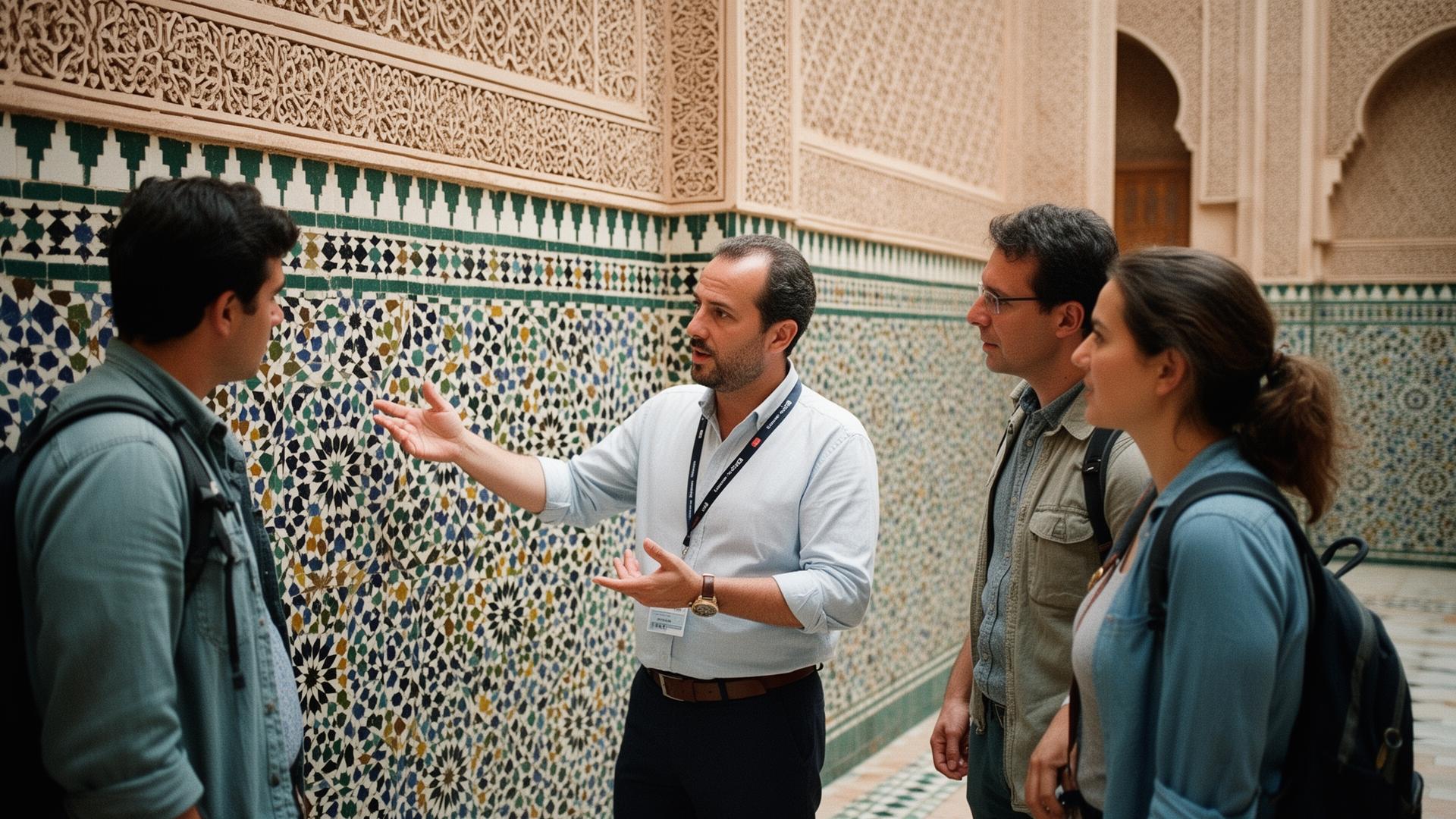
None of this means the medinas are off-limits — many travellers with reduced mobility do experience them, on their own terms and at a chosen pace, often dipping in for a short, guided visit to a particular square or monument rather than attempting to cover the whole quarter. A knowledgeable local guide who knows the smoothest routes and the quieter hours makes a real difference, and can plan a visit around the most navigable streets.
- Expect cobbles, uneven paving, steps and steep gradients throughout the historic cores.
- Lanes are narrow and car-free; mopeds and handcarts share the space, so crowds can be hard to pass.
- Kerb ramps and dropped kerbs are rare; surfaces change abruptly.
- Consider short, guided, targeted visits rather than attempting a full medina crossing.
Where access is genuinely easier
Casablanca's Hassan II Mosque is one of Morocco's most accessible major sights — a vast, modern complex on a flat seafront esplanade, with level approaches and a guided visit programme that is broadly wheelchair-friendly (confirm current arrangements when booking your slot). Rabat, the relaxed capital, mixes a manageable medina with wide, modern avenues and a tram system. Casablanca too is largely a modern city of broad boulevards.
On the coast, Agadir is the easiest base in the country for many: rebuilt on a modern grid after the 1960 earthquake, it offers flat streets, a long paved beachfront promenade and resort hotels designed to international standards. Essaouira's seafront and main square are reasonably flat, though its small medina still has the usual uneven surfaces. Across the country, the Villes Nouvelles — the French-era and modern new towns beside each historic city — generally have wider pavements and level ground, even if crossings can still be uneven.
- Hassan II Mosque, Casablanca: modern, largely accessible; check current visit arrangements.
- Agadir: flat modern grid, seafront promenade, resort-standard hotels — the easiest coastal base.
- Rabat and Casablanca: modern districts, wide avenues, tram lines.
- Villes Nouvelles everywhere: more level and spacious than the medinas they adjoin.
Getting around: transport and trains
Private adapted transport is the backbone of accessible travel here. A pre-arranged private vehicle with a driver who understands your needs gives you door-to-door flexibility, lets you skip the worst surfaces, and removes the stress of taxis. A handful of specialist Moroccan operators and inbound agencies arrange wheelchair-accessible vehicles, adapted tours and personal assistance; booking through one of them is the most reliable route to a smooth trip. Standard petit and grand taxis are plentiful and cheap but are not adapted, and boots are small.
The national rail network (ONCF), including the Al Boraq high-speed line between Tangier and Casablanca, is among the more modern in the region and the newer stations and trains include some accessible features such as lifts, ramps and dedicated spaces — though provision is not universal and assistance is best arranged ahead. Pavements and pedestrian crossings can be uneven and kerbs high even in modern areas, so factor in extra time and, where possible, a travelling companion or hired assistant.
- Pre-booked private adapted transport with a driver is the most reliable way to get around.
- Specialist accessible-travel operators exist; book vehicles and assistance in advance.
- ONCF/Al Boraq trains and newer stations have some accessible features — arrange assistance ahead.
- Ordinary taxis are not adapted; pavements and crossings can be uneven even in new districts.
Hotels and riads: what to ask before you book
Accommodation is where careful questions pay off most. Traditional riads are courtyard houses built around a central well of light, and many are charming but multi-storey with steep, narrow staircases and no lift — bedrooms are often on upper floors reached only by stairs. Some riads do have a ground-floor room or a lift, but you must ask specifically rather than assume. Modern hotels, particularly international chains in the new cities and the coastal resorts, are far more likely to offer step-free entrances, lifts and adapted bathrooms.
When you enquire, be precise about your needs and ask for photographs rather than relying on a property's own 'accessible' label, which is not standardised. A specialist operator can vet rooms on your behalf. The trade-off is real: a riad delivers atmosphere but often stairs, while a modern hotel trades some character for genuine step-free comfort — and many travellers split the difference across a trip.
- Ask: step-free entrance? lift, or ground-floor room? threshold heights? roll-in or low-step shower?
- Request photos of the room, bathroom and entrance — don't rely on an 'accessible' tag.
- Many riads are multi-storey with stairs and no lift; confirm before booking.
- Modern and international hotels in the new towns and resorts are the safer bet for step-free access.
Planning tips for a smoother trip
Plan a slower itinerary with fewer cities and longer stays, basing yourself in easier hubs and taking targeted day excursions rather than constant movement. Bring your own essential equipment and any spares — specialist repairs and parts can be hard to find — and consider a lightweight, robust wheelchair if you use one, given the surfaces. Travel insurance that explicitly covers your condition and any equipment is essential.
Moroccans are, as a rule, warm and willing to help, and you will rarely be short of hands offering assistance — though formal infrastructure lags behind that goodwill. Cooler months (autumn to spring) make the inevitable extra effort far more comfortable than the summer heat. Above all, go in with eyes open: with honest expectations, the right base, private transport and a good operator, Morocco is challenging in places but absolutely achievable, and deeply rewarding.
- Fewer bases, longer stays, slower pace; pick easier hubs and make targeted excursions.
- Bring your own equipment and spares; parts and repairs are hard to source locally.
- Buy insurance that explicitly covers your condition and mobility equipment.
- Travel in autumn–spring to avoid the heat, which compounds every access challenge.
Frequently asked
Is Morocco wheelchair accessible?
Partly. The historic medinas of Fes, Marrakech and Chefchaouen are very difficult for wheelchair users — cobbled, stepped, narrow and car-free, with almost no kerb ramps. But the modern Villes Nouvelles, the city of Agadir, Rabat and Casablanca's modern districts, and the Hassan II Mosque are far more manageable, and specialist operators provide adapted vehicles and assistance. With the right base and private transport, a good trip is very possible.
Which parts of Morocco are easiest for reduced mobility?
Agadir is the easiest base — a modern, flat, grid-planned resort city with a paved seafront. Rabat and Casablanca have wide, level modern districts and tram lines, and the Hassan II Mosque is largely accessible. The new towns (Villes Nouvelles) beside every historic city are more level and spacious than the medinas, even if crossings can be uneven.
Are riads suitable for travellers with limited mobility?
It depends on the property. Many riads are multi-storey courtyard houses with steep, narrow staircases and no lift, with bedrooms on upper floors. Some have a ground-floor room or a lift, but you must ask specifically and request photos. Modern hotels in the new cities and coastal resorts are generally a safer choice for step-free access and adapted bathrooms.
Can I get accessible transport in Morocco?
Yes, but arrange it in advance. Ordinary taxis are not adapted, so the reliable option is a pre-booked private vehicle with a driver, ideally through a specialist accessible-travel operator who can supply a wheelchair-accessible vehicle and personal assistance. The ONCF and Al Boraq trains and newer stations include some accessible features, with assistance best requested ahead.
Is the Hassan II Mosque accessible?
Largely, yes. It is a modern complex on a flat seafront esplanade with level approaches, and its guided visit programme is broadly wheelchair-friendly — one of the more accessible major monuments in Morocco. Confirm the current visit and assistance arrangements when you book your timed slot.
Planning a trip?
Let a Marrakech atelier handle the details.
Tell us your dates and style and we'll send a written itinerary and a transparent quote within 24 hours.
Request an itineraryKeep reading
Practical
Getting Around Morocco
Morocco has good trains between the main northern cities, comfortable intercity buses, and — for the south, the mountains and the desert — private drivers. The right mix depends on your route and pace.
Planning
Where to Stay in Morocco: Riads, Hotels & Desert Camps
Morocco offers one of the world's great accommodation experiences — from intimate medina riads with plunge pools and private chefs to luxury Sahara tented camps and Atlantic coast boutique hotels. Knowing which type suits your trip, and what to look for in each, makes a significant difference.
Planning
Things to Do in Agadir: The Essential Guide
Agadir is Morocco's beach resort capital — rebuilt from scratch after a 1960 earthquake and shaped primarily around its 10 km of Atlantic sand, year-round sunshine and package-holiday infrastructure. It is also the gateway to the Souss Valley, the argan forests and the surf coastline of Taghazout.
Planning
Things to Do in Casablanca: The Essential Guide
Casablanca is Morocco's economic capital and largest city — a modern, cosmopolitan metropolis built on Atlantic commerce rather than imperial history. Its centrepiece, the Hassan II Mosque, is among the most extraordinary buildings in the world, and the city's restaurants, Corniche and Art Deco architecture reward those who linger beyond the airport transfer.