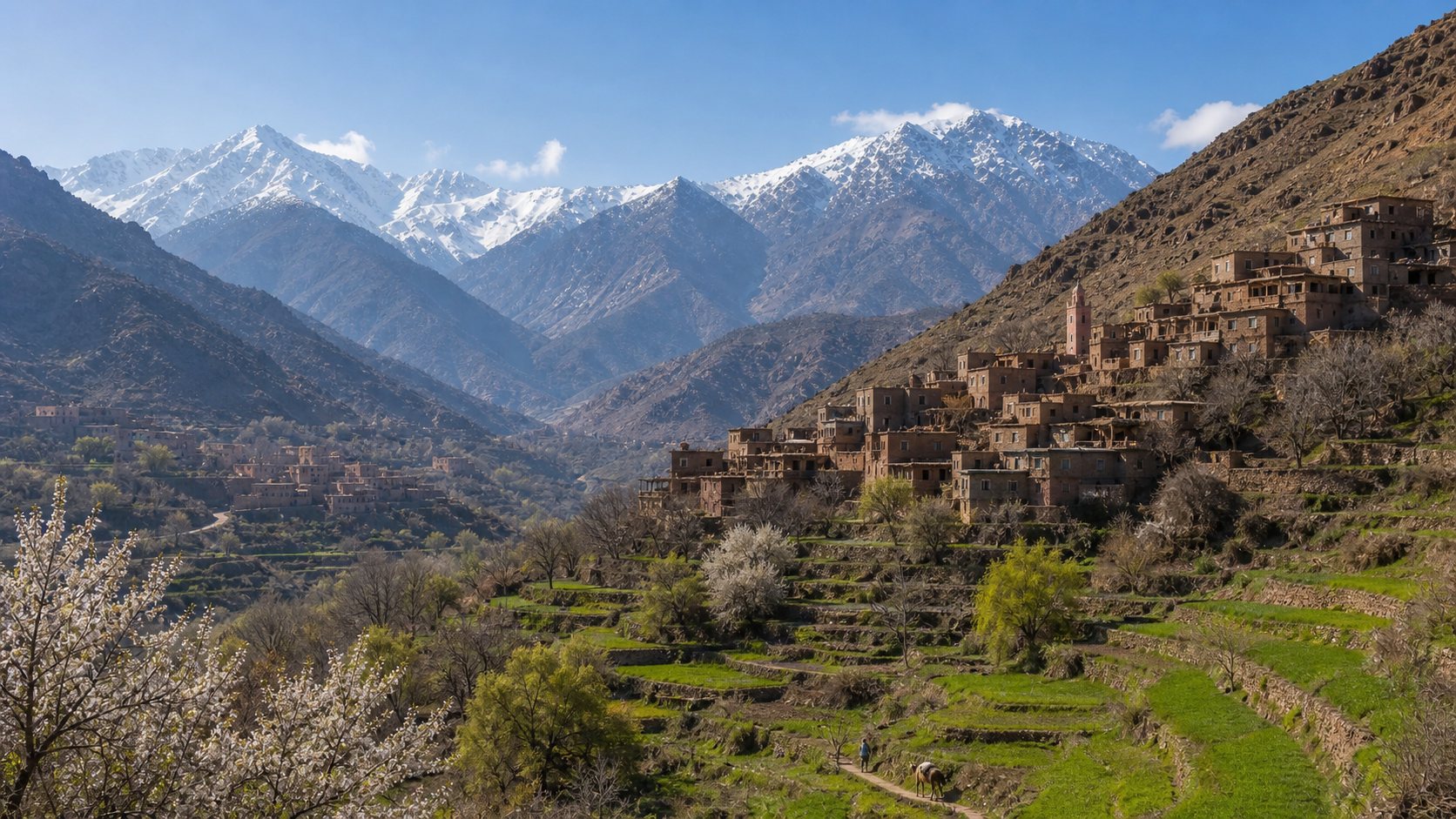
Aït Bougmez Valley

High Atlas · M'Goun massif

Aït Bougmez Valley, Morocco

Aït Bougmez is Morocco's 'Happy Valley' — a remote High Atlas sanctuary of terraced Berber villages, wildflower meadows and the trailhead for the M'Goun massif.

Best time

May–October (the valley road from Azilal can be blocked by snow November–April; best trekking June–September)

Recommended

2–4 days

Airport

Marrakech Menara (RAK) + 3h30 drive via Azilal

Region

High Atlas · M'Goun massif

Aït Bougmez (Tamazight: ⴰⵢⵜ ⴱⵓⴳⵎⴶ, also written Ait Bou Guemez) is a broad glacial valley at roughly 1,800–2,000 m in the central High Atlas, situated within the M'Goun massif — the second-highest mountain range in Morocco after Toubkal. The valley stretches roughly 30 km east–west and contains a chain of twenty-six Berber villages, their flat-roofed earthen houses terracing the slopes above irrigated wheat, barley and apple orchards. It earned the nickname 'la vallée heureuse' (the Happy Valley) from French geographers in the colonial period for its exceptional fertility and the relative prosperity of its communities compared to the surrounding mountains. Access requires a long, winding road from Azilal (62 km, about 2 hours) or the seasonal pass from the Dadès Valley. Jbel M'Goun (4,068 m), the second-highest summit in Morocco, dominates the eastern end of the valley and is the objective for the M'Goun traverse — one of the finest multi-day treks in North Africa.

What to see

Highlights of Aït Bougmez Valley

01

What makes the M'Goun traverse one of Morocco's finest treks?

The M'Goun massif traverse is a 5–7 day high-altitude route crossing Jbel M'Goun (4,068 m) and the surrounding ridges, linking the Aït Bougmez valley to the Dadès Gorge in the south. The route threads through remote Berber villages, high-altitude plateaux carpeted in wildflowers, narrow gorges and passes above 3,000 m — with very few other trekkers, unlike the Toubkal circuit. A licensed guide and mule support are required.

02

Berber villages and communal granaries

The twenty-six villages of the Aït Bougmez valley include some of the best-preserved examples of High Atlas Berber architecture: flat-roofed earthen houses, communal agadirs (collective granaries) on the hillside, and painted doors in the Amazigh tradition. Tabant is the administrative centre; the villages of Agouti and Imelghas are particularly photogenic and accessible on foot.

03

Wildflower meadows and the glacial valley floor

The flat valley floor is a patchwork of irrigated orchards, wheat fields and wildflower meadows from May to September — poppies, iris, yellow crown daisy and dozens of Atlas endemics bloom at altitude. Walking the valley floor between villages, with the snowfields of M'Goun above, is one of the most beautiful pastoral walks in the Atlas.

04

Lake Tislit and the Izourar plateau

At the head of the valley, a rough track climbs to Lake Tislit at 2,527 m — a glacially formed mountain lake in a high cirque, reflecting the M'Goun ridgeline. The plateau above it, the Plateau des Lacs, holds several further lakes and is the starting point for the M'Goun summit route.

Itineraries

Our Aït Bougmez Valley tours

Every itinerary below is privately operated, fully customisable, and includes a deep stop in Aït Bougmez Valley. Click any tour for the day-by-day plan, the map, dates and pricing.

6 days

M'Goun traverse

Six days crossing the M'Goun massif from Aït Bougmez to the Dadès Gorge: high passes, remote villages, summit option (4,068 m) and mule support.

from $1,480Enquire →
3 days

Aït Bougmez valley stay

Three days in the Happy Valley: village walks, the communal granaries, Lake Tislit and an overnight in a traditional Berber gîte.

from $680Enquire →

Before you go

Practical notes

  • Getting there: 3h30 from Marrakech: 2h to Azilal on the N8, then 1h30 on a winding mountain road to Tabant — the valley's main village
  • Accommodation: Gîtes d'étape (mountain lodges) in Tabant and several villages — basic but comfortable; book ahead in summer
  • Trekking guide: A licensed mountain guide is required for the M'Goun summit and the full traverse; village walks can be done independently with a map
  • Road conditions: The road from Azilal is paved but narrow and winding; the seasonal pass from the Dadès side requires a 4x4 and is often closed October–May

Concierge

Have your Aït Bougmez Valley trip designed by a local

Tell us your dates, group size and pace. We'll send back a written proposal within 24 hours — private guides, transfers, riads, the lot.

Request a proposal →

FAQ

Aït Bougmez Valley — common questions

How difficult is the Aït Bougmez valley road from Azilal?+

The 62 km road from Azilal is paved throughout but takes about 1h30–2h due to tight switchbacks and the altitude gain. Any standard car can manage it in good conditions; it can be treacherous in snow or heavy rain. The scenery — terraced villages, cedar slopes, views back across the Tadla plain — makes the drive itself rewarding.

Is Jbel M'Goun harder than Toubkal?+

M'Goun (4,068 m) is technically comparable to Toubkal (4,167 m) in summer — a long, steep walk without technical climbing. The key difference is logistics and remoteness: the M'Goun traverse is a multi-day route through genuinely isolated terrain, requiring more self-sufficiency and planning than the Toubkal weekend ascent. It is less visited and arguably more rewarding for experienced trekkers.

What is the best time to visit Aït Bougmez?+

June through September is the prime season: the valley is green, the wildflowers are in bloom, the M'Goun routes are snow-free, and gîtes are open and staffed. May and October are transitional months — usually fine but occasionally snowy at altitude. The road from Azilal can be blocked November–April.

Can I visit Aït Bougmez without trekking?+

Yes — the valley floor and the lower village circuit are gentle walks suitable for most active travellers. Driving through the chain of villages, visiting the communal agadir and walking to Lake Tislit are all achievable without high-altitude trekking fitness. The valley is the destination in itself.