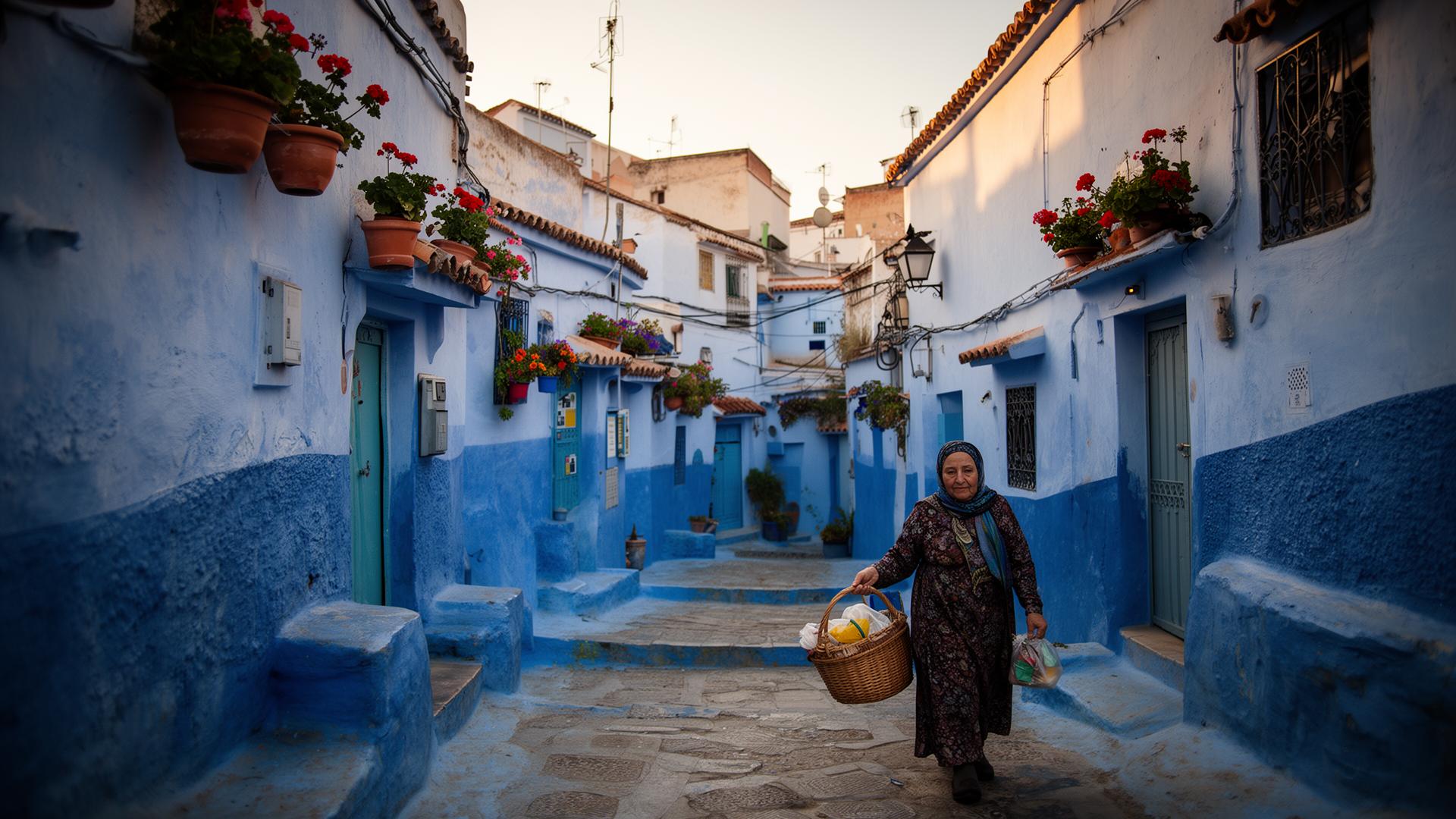
Morocco has two images recognised the world over: the frenetic ochre labyrinth of Marrakech's medina, and the dreamlike blue alleyways of Chefchaouen in the Rif mountains. They lie 600 km apart and attract overlapping but distinct audiences. Marrakech is Morocco distilled — an 11th-century imperial capital where Jemaa el-Fna square stages its daily carnival, where souks sell saffron and babouche slippers in the shadow of the Koutoubia minaret, and where the desert is a long but doable day's drive south. It is large (one million people), cosmopolitan and occasionally overwhelming. Chefchaouen, by contrast, is small (45,000 people), intimate and visually intoxicating: every surface from doorstep to rooftop is brushed in indigo, cerulean, periwinkle or cobalt, and the mountain air at 600 m carries pine resin and the sound of the Ras el-Ma river running through town. The question is not which is better — both belong in a thorough Morocco itinerary — but which fits the trip you are building right now.
Option A
Marrakech
The Red City — souks, palaces, Sahara gateway and a medina 11 centuries old
Best for
First-time Morocco visitors, couples, desert-bound travellers, luxury stays
Full guideOption B
Chefchaouen
The Blue Pearl of the Rif — a compact mountain town of blue-washed lanes
Best for
Photographers, Instagram travellers, those seeking calm after a busy itinerary
Full guideSide-by-side breakdown
Marrakech vs Chefchaouen: how they compare
| Category | Marrakech | Chefchaouen |
|---|---|---|
| Size & setting | City of 1 million; ancient medina on a plain at 450 m; heat in summer | Town of 45,000; compact Rif mountain medina at 600 m; cool year-round |
| Vibe | Intense, cosmopolitan, theatrical; overwhelming and seductive simultaneously | Calm, photogenic, unhurried; backpackers and day-trippers coexist peacefully |
| Iconic experience | Jemaa el-Fna at dusk; Majorelle Garden; Bahia Palace; souk labyrinth | Blue lane wandering; Uta el-Hammam square; viewpoint above the medina at sunrise |
| Time to explore | 3–5 days for highlights; could spend a week comfortably | 1–2 nights adequate; 3 nights with a day hike to Akchour gorge |
| Getting there | Marrakech Menara Airport (RAK): 40+ direct European routes | No airport; closest is Tangier (3 h drive) or Fes (3.5 h drive) |
| Accommodation | Every tier: budget hostels, medina riads, five-star palmery resorts | Medina guesthouses and small riads; limited luxury; prices lower than Marrakech |
| Desert & day-trip access | Agafay desert 35 km; Ourika Valley 35 km; Essaouira 2.5 h; Sahara 9 h | Akchour gorge day hike; Rif mountain walks; Fes 3.5 h; Tangier 3 h |
| Best season | October–April; July–August reaches 38–42°C — manageable with early starts | Year-round pleasant; January–February can be cold and wet; spring ideal |
Our verdict
Which should you choose?
Start with Marrakech if this is your first Morocco trip: its airport connectivity, infrastructure and sheer density of unmissable sights make it the natural entry point. Add Chefchaouen — ideally on a return visit or as part of a longer northern Morocco loop — for the mountain calm and visual magic that no other town in the country replicates. If you are building a single itinerary that includes both, fly into Marrakech, spend three to four nights, then fly to Fes (RAM connects them in under an hour) and drive or bus to Chefchaouen for two to three nights before flying home from Tangier.
Deep dives
Explore each destination in full
FAQ
Frequently asked questions
How far is Chefchaouen from Marrakech?
Chefchaouen and Marrakech are approximately 600 km apart by road — around 7 to 8 hours drive via Casablanca and Fes, or slightly less via Rabat. There is no direct train or bus; most travellers fly between the two cities (Marrakech to Fes or Tangier) and then travel overland to Chefchaouen.
Is Chefchaouen worth visiting if I have already seen Marrakech?
Absolutely. Chefchaouen offers everything Marrakech does not: mountain air, a compact and manageable medina, genuine quiet and a visual character unlike anywhere else in Morocco. Many travellers find it the highlight of their northern Morocco leg precisely because it is so different from the imperial city experience.
Why is Chefchaouen painted blue?
The most widely cited explanation is that Jewish refugees fleeing the Spanish Inquisition in 1494 painted the buildings blue — a colour traditionally associated with heaven and spiritual devotion. The tradition was maintained and expanded by subsequent communities. Today the medina is repainted annually, and the specific shade of blue varies from street to street.
Is Marrakech or Chefchaouen better for photography?
Both are exceptional but for entirely different reasons. Chefchaouen is unmatched for colour photography: its uniform blue palette, narrow lanes, flower pots and cats create ready-made compositions at every turn. Marrakech offers drama and scale: tannery rooftop panoramas, geometric souk patterns, Majorelle Garden's electric blue-and-yellow palette, and Jemaa el-Fna's human theatre at sunset.
Can I combine Marrakech and Chefchaouen in one week?
It is possible but tight. The most practical approach: three nights in Marrakech, fly to Fes (55 min with RAM or Air Arabia), bus or taxi to Chefchaouen (3.5 h) for two nights, return to Fes and fly home. Driving the entire route is enjoyable but consumes a full day each way — better suited to a 10-day trip.
Ready to book?
Let a Marrakech atelier build your itinerary.
Tell us which destinations you want to combine and we'll send a written itinerary and a transparent quote within 24 hours.
Keep comparing
All destination comparisons